Do delivery drivers and couriers need hi vis?
Last updated
What hi vis means for delivery work
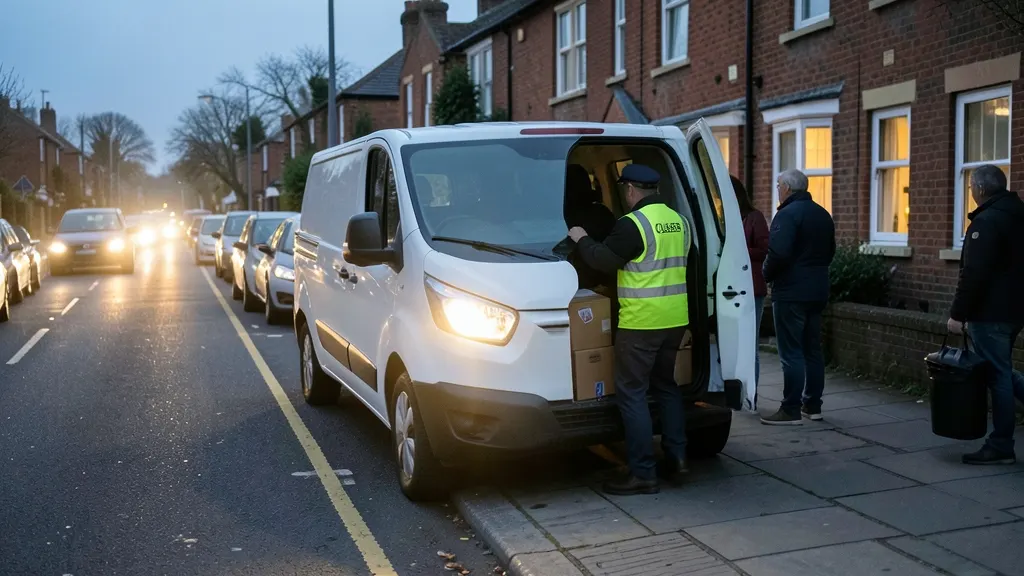
If you drive a van, ride a bike or walk parcels to the door for a living, hi vis is part of your daily kit. Courier high visibility clothing is simply clothing made from fluorescent material that shows up in daylight and poor light, combined with retroreflective bands that bounce headlight beams back at drivers after dark. For delivery drivers it matters most at the moments you step out of the vehicle: reversing bays, lay-bys, kerbsides and customers' driveways are all places where you are a pedestrian near moving traffic.
The question "do delivery drivers need hi vis" has a short answer and a longer one. The short answer is that it depends on who you work for and where you work. The longer answer is that even where no one forces you to wear it, the Highway Code and common sense both point the same way.
What the rules say
There is no single UK law that says every courier must wear a yellow jacket. Instead, the duty falls on employers under the Personal Protective Equipment at Work Regulations 1992. These regulations say employers must provide suitable PPE to workers exposed to a risk to their health or safety, unless that risk is adequately controlled by other means. If your employer decides traffic is a risk when you load, unload or walk between stops, they must give you hi vis that suits the job.
Since 6 April 2022 these duties also cover limb (b) workers, which includes many agency and gig economy couriers. The employer must provide the PPE free of charge. So if you are a casual courier engaged through an app or an agency, your position is stronger than it used to be: the company should be supplying and paying for your hi vis, not you.
The garments themselves are graded under EN ISO 20471, which has three classes. The classes are based on how much fluorescent background material and how much retroreflective material the garment contains. A class 1 item has a minimum fluorescent area of 0.14 m2 and at least 0.10 m2 of retroreflective material. Class 2 requires 0.50 m2 of fluorescent material and 0.13 m2 of retroreflective material. Class 3, the highest, needs at least 0.80 m2 of fluorescent background and 0.20 m2 of retroreflective material. If you want to understand the differences in detail, see our guide on Hi-vis classes and EN ISO 20471 explained.
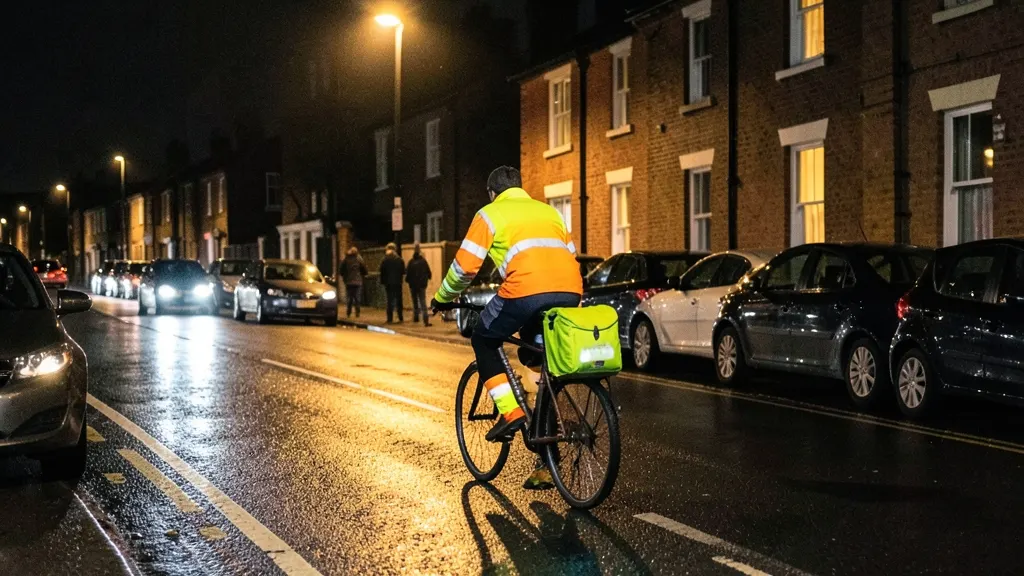
The Highway Code backs all this up. Rule 3 asks all road users to help others see them, and notes that in the dark, reflective materials such as armbands, sashes, waistcoats, jackets or footwear can be seen by drivers using headlights up to three times as far away as non-reflective materials. Rule 17 tells pedestrians, which is what you become when you step out of the van, to wear something reflective at night. If your round involves cycling, Rule 59 says light-coloured or fluorescent clothing helps in daylight and poor light, while reflective belts, arm or ankle bands help in the dark. Rule 60 adds that at night a cycle must have a white front light and a red rear light lit, plus a red rear reflector.
How it works in practice on UK roads
For most van drivers, a class 2 vest is the working minimum. It gives a sensible balance of visibility, breathability and cost, and it is the level most depots and sites expect at their gates. Class 3 jackets and trousers are worth considering if you spend long shifts on foot near fast traffic, for example on trunk roads, in distribution yards or on night shifts. Many people who already wear hi vis at work find our guide to When hi-vis is required at work in the UK useful for working out which situations carry a formal requirement.
Hi vis when loading and unloading deserves special attention. You are often leaning into the back of a van, crouched at a tail lift or standing between parked vehicles, which hides you from passing drivers at exactly the moment you are most vulnerable. A vest that is visible from all sides, including bands that show when your jacket is open or your arms are raised, helps here. Keep the vest on until you are back in the cab, not slung over the passenger seat.
Looking after the kit is part of the job too. HSE guidance says reusable PPE must be cleaned and kept in good condition, and that hi-vis jackets, trousers and coveralls must be cleaned regularly. Dirt, grease and creasing all dull the fluorescent and reflective performance. Workers must report any loss, destruction or obvious defect, so if your vest is grey with grime or a reflective band is peeling off, ask for a replacement rather than pushing on with it.
Cyclist couriers should think beyond the vest. Reflective bands around the ankles move as you pedal, which catches drivers' eyes. A bright backpack cover helps from behind, where you are widest and least visible. And follow the ordinary rules of the road: Rule 69 says cyclists must obey all traffic signs and traffic light signals, and riding predictably matters as much as what you wear. Riders of any kind who share lanes with faster traffic can pick up extra tips from our article on Hi-vis for horse riders on the road, since the same visibility principles apply.
One quirk worth knowing: if your delivery work ever takes you onto railway property, the standard changes. SATRA, a UK PPE testing body, states that rail standard RIS-3279-TOM requires an orange colour and garments meeting at least class 2 of EN ISO 20471. So hi vis for van drivers doing work near the rail network may need to be orange rather than yellow.
Where to read more
The key sources are the Personal Protective Equipment at Work Regulations 1992 and the HSE guidance that goes with them, the Highway Code, and the EN ISO 20471 standard itself. Your employer's risk assessment should tell you which class of garment your routes require. If you are self-employed, you are your own duty holder, so run through the same questions: where do I step out near traffic, in what light, and for how long? Then pick the class and fit that answers those questions.
Frequently asked questions
Do I legally have to wear hi vis as a courier?
There is no law that names couriers specifically. However, under the Personal Protective Equipment at Work Regulations 1992, employers must provide suitable PPE where workers face a health or safety risk that is not controlled by other means. Since 6 April 2022 this also covers limb (b) workers, and the employer must supply the PPE free of charge. Many depots and customer sites also make hi vis a condition of entry.
What class of hi vis should a delivery driver wear?
A class 2 vest or jacket is the usual choice for van drivers, with at least 0.50 m2 of fluorescent material and 0.13 m2 of retroreflective material. Class 3, which requires 0.80 m2 of fluorescent background and 0.20 m2 of retroreflective material, is better for night shifts or long periods on foot near fast traffic.
Do I need hi vis just to walk a parcel to the door?
The Highway Code says that in the dark, reflective materials can be seen by drivers using headlights up to three times as far away as non-reflective materials, and Rule 17 asks pedestrians to wear something reflective at night. For a few seconds on a quiet cul-de-sac the risk is low, but on main roads, unlit rural lanes and industrial estates a vest is worth wearing for every stop.
How often should hi vis clothing be washed?
HSE guidance says reusable PPE must be cleaned and kept in good condition, and hi vis jackets, trousers and coveralls must be cleaned regularly. Grime and creasing reduce both the fluorescent and reflective performance. Workers must report any loss, destruction or obvious defect, so a faded or torn garment should be replaced, not patched up.
Does hi vis for delivery work have to be yellow?
Not usually. Yellow is common because it stands out in most settings, but orange is required in certain circumstances. SATRA, a UK PPE testing body, states that rail standard RIS-3279-TOM requires an orange colour meeting at least class 2 of EN ISO 20471, which matters if your work takes you onto railway property.