Dog walking at night: a practical guide to staying visible
Last updated
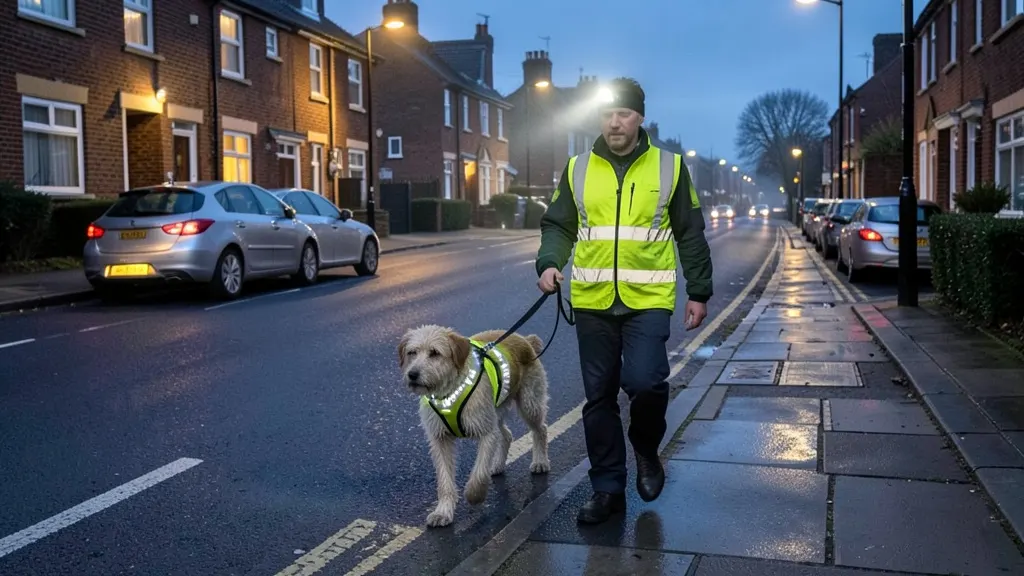
Walking a dog in the dark is part of life for most UK dog owners from autumn through to spring. Early sunsets mean many walks happen before or after work, often along unlit lanes, pavements and park paths. The goal of this guide is simple: make sure drivers, cyclists and other pedestrians can see you and your dog from as far away as possible, and that you can see where you are walking. You do not need much kit to do it well.
What you need
At a minimum you want something reflective on yourself and something reflective on the dog. A reflective vest, sash, armband or jacket works for you, and a reflective harness, collar or coat works for the dog. Add a small torch or head torch so you can see the path, and a lead light or light-up attachment so the dog itself shows up rather than just moving reflectors. A flashing light on the dog's collar or harness helps drivers judge distance and movement, which is one of the trickiest things for a driver at night.
The Highway Code is clear on the principle. Rule 3 says that in the dark you should use reflective materials such as armbands, sashes, waistcoats, jackets or footwear, and that drivers using headlights can see reflective materials up to three times as far away as non-reflective ones. Rule 17 makes the same point for pedestrians: at night, wear something reflective to make it easier for others to see you. Those three times as far can be the difference between a driver slowing down in good time and not seeing you at all.
For a deeper look at how hi-vis garments are classified, see our guide to Hi-vis classes and EN ISO 20471 explained. You do not need the highest class for a dog walk, but knowing what the labels mean helps you choose kit that actually works.
Steps to be seen on a night dog walk
- Put reflective kit on yourself before you leave the house. A vest or sash over your coat is the easiest option because it goes over bulky winter layers without fuss. Reflective bands on wrists and ankles move as you walk, and moving reflectors catch a driver's eye better than static ones.
- Fit reflective gear on the dog, not just a collar. A collar is often hidden by fur, a coat or the dog's posture. A reflective harness or coat covers more of the dog, and a light-up collar or clip light makes the dog visible even where there is no traffic to shine a headlight beam on it.
- Choose your route with light in mind. Lit pavements and residential streets beat unlit lanes. If you must walk an unlit road, walk on the side facing oncoming traffic so you can see vehicles and they can see you sooner. Cross at lit places where drivers expect people.
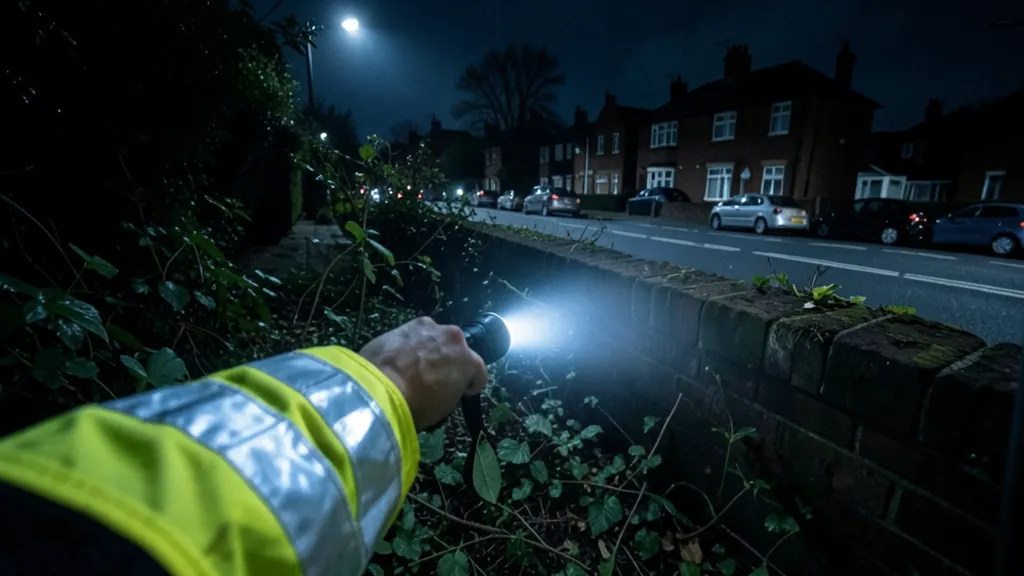
- Carry a torch or head torch. You need to see potholes, kerbs, ice and the dog. A head torch keeps your hands free for the lead and poo bags. Some walkers use a torch held low to spot eyes reflecting in hedges too.
- Keep the lead short near roads. A dog on a long extendable lead can end up metres from you, in the road edge or invisible in shadow. A short lead keeps the dog inside your own visible footprint.
- Check your kit works before dark. Step outside with the dog and shine a torch or phone light at yourself and the dog. If the reflectors barely glow, the kit is worn out or fake and should be replaced.
- Wash reflective kit according to the label. Reflective strips and fluorescent fabric lose performance when caked in mud or washed incorrectly. Dirty kit reflects less light, and muck on a dog coat hides the reflective piping entirely.
The same habits that help on winter dog walks help on other dark journeys. If you combine the school run with the dog walk, our advice on Hi-vis for school children applies just as much to the children as to you.
Common mistakes and how to fix them
Relying on a dark coat with a small logo. A black or navy winter coat with a tiny reflective trim is close to invisible at night. Fix it by adding a reflective vest, sash or armbands over the top. Coverage matters more than the garment underneath.
Assuming the dog's coat colour is enough. A pale dog is easier to see than a black one, but colour alone is not dog walking at night visibility. Reflective and light-up kit does the job whatever colour the dog is.
Walking with the flow of traffic behind you. On rural roads especially, walking with traffic behind you means you cannot see what is coming and a driver sees you late. Face oncoming traffic and keep the dog on the kerbside.
Letting the dog run loose near roads in the dark. Off-lead freedom is fine in a lit park, but near traffic the dog must be on a lead. Even a lit dog is hard for a driver to interpret at distance.
Forgetting the return leg. Many walkers dress well for the outward leg in town, then take an unlit shortcut home tired. Plan visibility for the whole route, not just part of it.
The same principles apply on two wheels in winter. Cyclists have their own rules, including Rule 59, which says reflective clothing or accessories such as belts, arm or ankle bands increase visibility in the dark. If you swap the dog lead for handlebars, see Staying visible on winter commutes.
When to stop repairing and replace instead
Reflective and light-up kit is not expensive, and worn kit is worse than it looks because failures are invisible until they matter. Replace your reflective items when:
- The reflective strips no longer glow brightly when you test them with a torch or headlights.
- Fabric is faded, worn thin at the shoulders, or the retroreflective bands are cracked or peeling.
- A light-up collar or clip light no longer holds charge, flickers, or lets in water.
- A dog coat no longer fits after a growth spurt or weight change, because loose fabric hides reflectors and catches on hedges.
- Elastic armbands or sash fastenings have lost their stretch, so the item slips and ends up hidden under a coat.
Clean kit lasts longer, so wash reflective garments regularly and gently, and let the dog's reflective coat dry naturally rather than on a radiator. After each walk, give muddy gear a quick brush off before it dries hard. Check the dog's light batteries every few weeks during winter rather than discovering a dead light at the park gate.
Dog walking safety in the dark comes down to three habits: reflective coverage on you, reflective and light-up kit on the dog, and a route chosen with light and traffic in mind. Get those right and the winter walk stays what it should be, a routine errand rather than a risk.
Frequently asked questions
How can I be seen walking a dog at night?
Wear something reflective yourself, such as a vest, sash or armbands, and put reflective or light-up kit on the dog, such as a harness, coat or collar light. The Highway Code's Rule 3 says drivers using headlights can see reflective materials up to three times as far away as non-reflective ones. Carry a torch so you can also see the path, and walk facing oncoming traffic on unlit roads.
Does my dog need hi-vis as well as me?
Yes. A reflective harness, coat or light-up collar makes the dog visible in its own right, and it stops the dog drifting outside your visible footprint on a long lead. A collar alone is often hidden by fur, so cover more of the dog if you can.
Is a torch enough instead of reflective clothing?
A torch helps you see the ground, and some light does spill onto you, but it is not a substitute for reflective kit. A torch can be pointed the wrong way or dazzle drivers, while retroreflective material on your body and the dog shows up whenever headlights hit it.
How do I check my reflective kit still works?
Take the kit into a dark room or outside after sunset and shine a torch or car headlights at it from a distance. If the reflective strips glow clearly, the kit is working. If they are dull or patchy, or fabric is cracked and peeling, replace the item.
Where should I walk when dog walking in the dark?
Choose lit pavements and residential streets where possible, and cross at lit points where drivers expect pedestrians. If you must use an unlit lane, walk on the side facing oncoming traffic with the dog on a short lead on the kerbside.