Running in Bournemouth: a day in hi-vis
Last updated
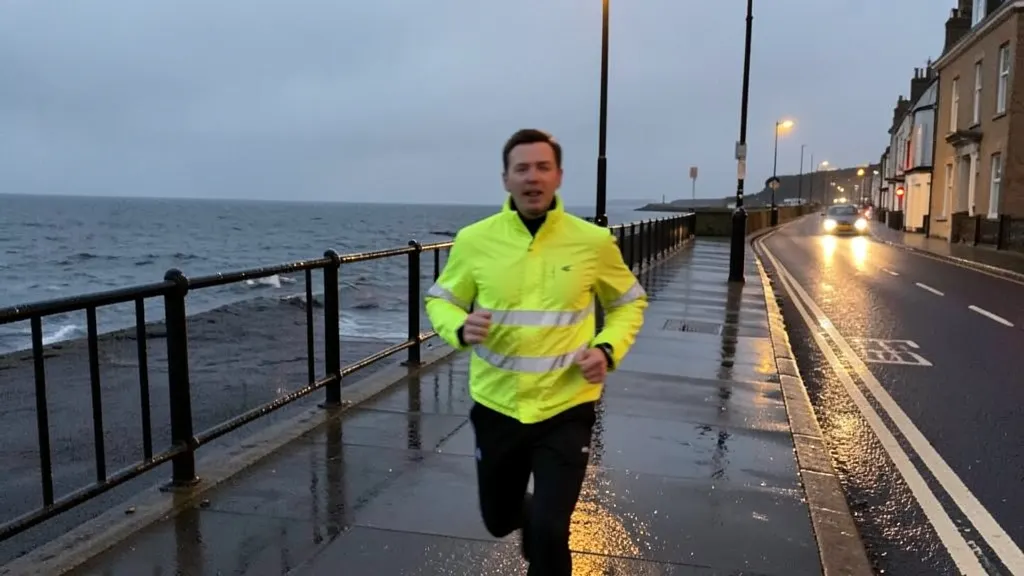
Bournemouth is a seaside town with a lot going on. Around 196,455 people live in the built-up area, and the local economy leans heavily on tourism and financial services. That mix means the place is busy all year, not just in summer, and plenty of those people run. The seafront is the big draw: a seven-mile stretch of golden sand, with cliffs cut by chines giving access to the shore. On top of that, the South West Coast Path ends at Poole Harbour and continues as the Bournemouth Coast Path to Milford on Sea, so long-distance routes pass straight through the area. If you run here, you have wonderful options, and for a good part of the year you will be doing some of it in the dark.
A winter's day on the run
Take a typical weekday in late December. Sunrise in Bournemouth on the winter solstice is at 08:06 and sunset is at 16:04, which gives just 7 hours and 58 minutes of daylight. A runner finishing work at five has already missed the light entirely. In fact, there are 117 days a year in Bournemouth when sunset comes before half past five in the evening or sunrise after quarter to eight in the morning, so even a normal commute, let alone a run, is partly in the dark.
The day might start with a short loop before work, streetlights on and the sky only just greying. Midday offers the one window of decent light, when the seafront is busy with walkers and the sand and pavements gleam wet from overnight rain. By late afternoon the light has gone again, and the evening run happens in full darkness with headlights sweeping along the promenade roads.
When visibility matters most
Not every stretch of a run carries the same risk. The moments to think about are:
- Crossing roads on the way to the seafront, where drivers are watching for traffic, not runners.
- Shared promenade sections, where pedestrians, cyclists and runners share a narrow space in poor light.
- Zigzagging down through a chine to reach the shore, where tree cover and shadow swallow what little light remains.
- Coastal sections after dark, where a runner without reflective detail is hard to pick out against dark water and dark sky.
The Highway Code is blunt on this. Rule 3 asks everyone to help other road users see them, and notes that in the dark, reflective materials such as armbands, sashes, waistcoats, jackets or footwear can be seen by drivers using headlights up to three times as far away as non-reflective materials. Rule 17 says at night, wear something reflective to make it easier for others to see you. That three-times figure is worth dwelling on. It is the difference between a driver reacting calmly and reacting late.
Kit that fits each moment
A running hi vis jacket is the backbone of it all. For daytime runs, fluorescent material does the work, because it shows up strongly in daylight and poor light. Once it is properly dark, fluorescent material stops doing much and reflective detail takes over, so a jacket with generous reflective panels is the one to reach for. Our guide to hi-vis jackets for running walks through the trade-offs.
Match the jacket to the moment:
- The pre-dawn road loop. A reflective running jacket with 360-degree detail, plus reflective bands at wrists and ankles, because movement catches a driver's eye.
- The chine descent. Something with reflective piping on the arms, since tree shade and tight turns hide a runner even under streetlights.
- The evening seafront run. A lighter running hi vis jacket with a chest light or clip-on light, so you can see the surface as well as be seen.
- Wet winter evenings. A waterproof hi vis jacket, because rain drops visibility for everyone and a soaked runner is a miserable runner.
If you want to understand why the reflective strips do their job, our piece on how reflective material works explains the glass bead and microprinciple ideas in plain terms. For runners who overlap with other activities, the wider Bournemouth hi-vis guide covers workplace and commuting kit too, and our article on what to wear running in the dark goes deeper on lights and accessories.
One takeaway
In a town this far south the winter light is short and the running is superb, and those two facts sit together for a third of the year. The single most useful thing you can do is wear a proper hi vis jacket on every run that starts or ends in the dark, with reflective detail at the moving parts of your body. Do that, and the seven miles of seafront, the chines and the long-distance path are all yours, in any season and any hour.
Frequently asked questions
Do I need hi-vis for running in Bournemouth?
There is no law requiring pedestrians or runners to wear hi-vis, but Bournemouth has 117 days a year when the light has gone before or never arrived by commuting times. The Highway Code's Rule 17 asks you to wear something reflective at night so others can see you. A running hi vis jacket makes that easy.
Is a fluorescent jacket enough in the dark?
Fluorescent material works best in daylight and poor light, but once it is fully dark it does little on its own. Reflective material is what headlights pick up, and under Rule 3 it can be seen by drivers up to three times as far away as non-reflective materials. Choose a jacket that has both.
What class of hi-vis do runners need?
EN ISO 20471 classes are aimed at workwear rather than running kit. Class 3, the highest, requires at least 0.80 m2 of fluorescent background material and 0.20 m2 of retroreflective material. Most runners do not need that much coverage, but more reflective area is never a bad thing on dark coastal roads.
When does it get dark in Bournemouth in winter?
On the winter solstice, sunrise is at 08:06 and sunset is at 16:04, giving 7 hours and 58 minutes of daylight. The clocks go back on 25 October 2026, when sunset falls at 16:55. Either way, evening runners spend a lot of the year in the dark.