Hi-vis for motorcyclists in Bournemouth
Last updated
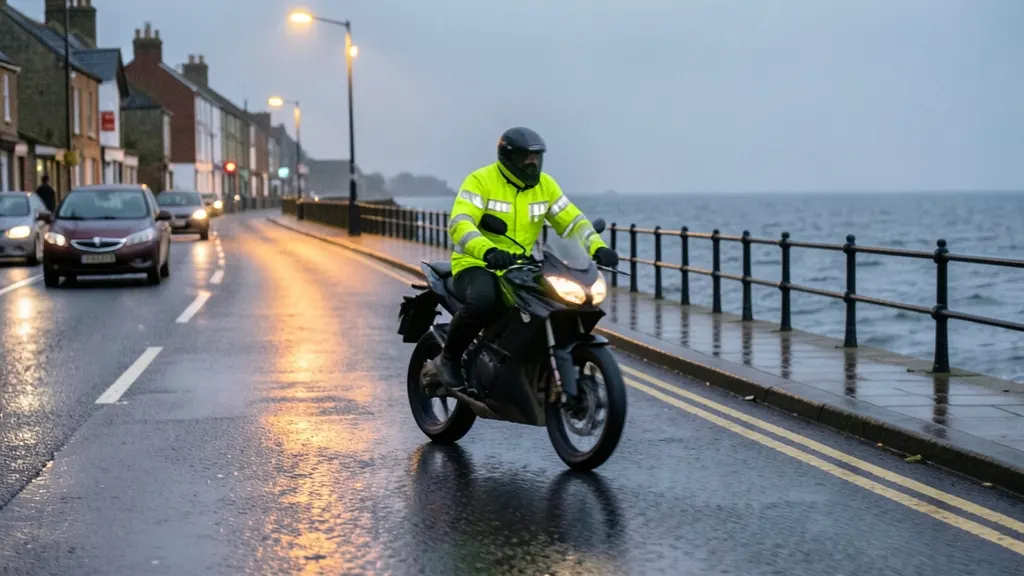
Bournemouth is a busy coastal town with a population of 196,455 in its built-up area, and its roads serve both a strong tourist trade and everyday commuters. Motorcyclists ride here all year round, along the seafront, through town, and out towards the countryside beyond. With 117 days a year when sunset falls before half past five in the evening or sunrise comes after quarter to eight in the morning, plenty of local rides happen partly or wholly in the dark. That makes visibility kit a genuine safety matter rather than an optional extra.
The questions riders actually ask
Does a hi vis motorbike jacket really make a difference?
Yes, in the right conditions. Fluorescent colours help in daylight and poor light, while retroreflective material comes into its own at night, when it bounces headlight beams back towards drivers. The highway code is clear on this point. Rule 86 advises motorcyclists to make themselves as visible as possible from the side as well as the front and rear, for example with fluorescent clothing or strips. Rule 87 goes further for riding in the dark, advising reflective clothing or strips. Ordinary dark riding gear can fade into the background on a grey coastal afternoon, so a hi vis motorbike jacket gives you a real advantage over leathers alone.
How far away can drivers see reflective material?
Rule 3 of the highway code states that reflective materials can be seen by drivers using headlights up to three times as far away as non-reflective materials. On an unlit road at night, that gap can be the difference between a driver reacting in time and reacting too late. More detail on the science is in our guide to how reflective material works.
What class of hi vis jacket do I need as a rider?
EN ISO 20471, the standard for high visibility clothing, has three classes. Class 1 requires at least 0.14 square metres of fluorescent background material, class 2 requires 0.50, and class 3 requires 0.80, with retroreflective areas of 0.10, 0.13 and 0.20 square metres respectively. Class 3 is the highest class. For motorcycling, there is no legal requirement to wear a certified class, so the choice is yours. Many riders choose a class 2 jacket for commuting, or a class 3 garment if they ride often on dark rural roads, where the greater visible area pays off. Our page on motorcycle hi vis jackets compares the options in more detail.
Is a hi vis jacket enough on its own?
It helps, but it is one layer of a wider approach. Keep your lights clean and working, position yourself where drivers can see you, and consider reflective strips or panels on your helmet and panniers. The highway code advice for motorcyclists is about visibility from every angle, and a jacket only covers part of you.
What changes in Bournemouth
Local conditions shape how much difference a hi vis jacket makes. Bournemouth sits on the coast, and sea air brings damp, misty mornings and drizzly evenings, especially from autumn onwards. Low winter sun is a familiar hazard on the seafront, where the seven-mile stretch of golden sand means light can strike horizontally off the water. Against low sun, a fluorescent yellow jacket may be less effective than you expect, so reflective panels matter as much as colour.
Daylight is short in winter. On the winter solstice in Bournemouth, sunrise is at 08:06 and sunset is at 16:04, giving just 7 hours and 58 minutes of daylight. If the clocks go back on 25 October 2026, sunset that day comes at 16:55, so the evening commute shifts into darkness almost at once. A rider travelling home at five in the afternoon through December will spend most of the journey in the dark, which is exactly the situation Rule 87 has in mind.
Coastal rain is the other factor. A jacket that soaks through stops being worn, so a waterproof hi vis jacket is the practical choice for Bournemouth weather. Look for sealed seams and a storm flap, and check how the reflective strips perform when wet, since some materials lose brightness under rain. Our guide to waterproof hi vis jackets covers what to check before buying.
Many local riders also head out of town at weekends into the surrounding countryside, including the New Forest national park, which covers 566 square kilometres across southwest Hampshire and southeast Wiltshire. Those roads are narrow, partly unlit and shared with walkers, cyclists and free-roaming animals. Side visibility, which Rule 86 highlights, matters most on lanes like these, where junction views are short and drivers are looking for cars rather than bikes.
Quick recommendations
- Wear a hi vis motorbike jacket on every commute, not just the dark winter ones. Fluorescent colour helps in poor daylight, and reflective panels take over after dusk.
- Choose at least class 2 under EN ISO 20471 for town riding, and consider class 3 if you regularly ride unlit rural roads after dark.
- Pick a waterproof hi vis jacket with decent reflective coverage, because Bournemouth weather will test it.
- Keep the jacket clean. Grime and road film dull both fluorescence and reflectivity, so wash it regularly and replace it when the reflective strips lose their shine.
- Store it under your seat or in a pannier so it is always with you, and check for damage before the clocks change each autumn.
For a broader look at kit through the colder months, read our winter hi vis jackets buyer's guide, and for a summary of the rules themselves see what the highway code says about hi-vis. You can also read our wider guide to hi-vis clothing in Bournemouth.
Frequently asked questions
Do motorcyclists have to wear hi vis by law?
No, there is no legal requirement for motorcyclists in the UK to wear hi-vis clothing. However, Rules 86 and 87 of the highway code advise motorcyclists to make themselves visible with fluorescent clothing or strips, and to wear reflective material when riding in the dark. Following this advice is sensible and can only improve your safety.
Which colour hi vis jacket is best for riding?
Fluorescent yellow is the most common choice and generally the most conspicuous in daylight. Fluorescent orange also works well and is sometimes preferred where yellow clashes with roadside machinery or signage. Whatever colour you pick, check that the retroreflective bands are generous, since they do the night work.
How long does a hi vis jacket stay effective?
Effectiveness fades as fluorescent fabric ages and reflective bands wear or get dirty. Wash the jacket regularly following the care label, and replace it when the reflective strips no longer glow brightly under headlights or the fabric has lost its colour. A jacket used daily on a motorbike typically needs replacing sooner than one worn occasionally.
Is a hi vis vest as good as a jacket?
A vest adds useful fluorescent and reflective coverage over your torso, but it leaves your arms dark, which matters for side visibility at junctions and roundabouts. A proper hi vis motorbike jacket covers more of you and fits better at speed, so it is usually the better choice for regular riding.