Hi-vis for dark winter commutes in Bradford
Last updated
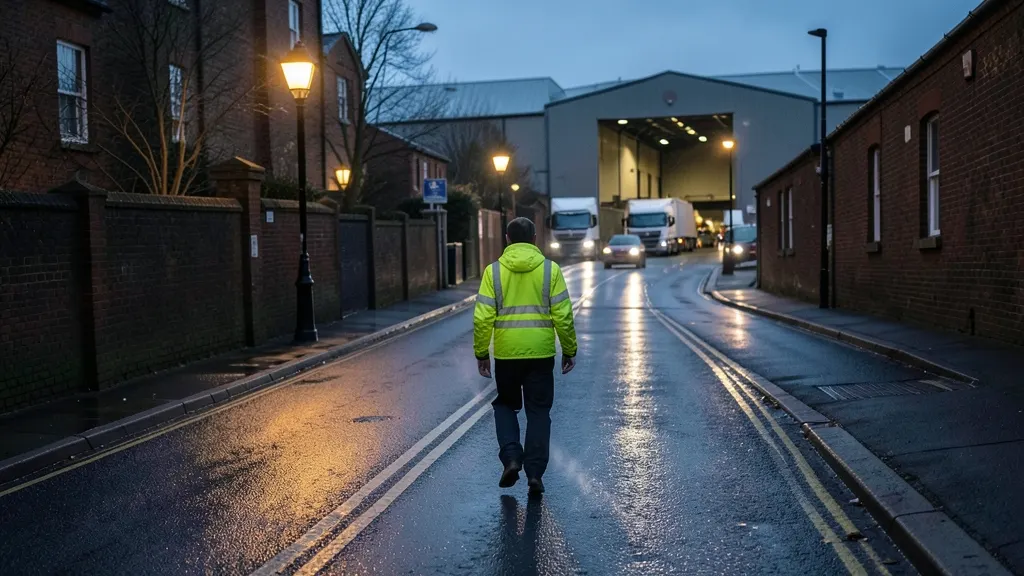
A working day in Bradford, from first light to last light
Bradford sits in the eastern foothills of a moorland region, and anyone who walks or rides across the city knows what that means in December: hills, and a lot of travelling in the dark. On the winter solstice, sunrise in Bradford is at 08:22 and sunset is at 15:47. That gives just 7 hours and 25 minutes of daylight, so a person starting work at nine and finishing at five will be heading home in full darkness for weeks on end.
Across the year as a whole, Bradford has 123 days when sunset comes before half past five or sunrise comes after quarter to eight. In other words, a normal commute is partly in the dark for a good third of the year. When the clocks go back on 25 October 2026, sunset that day is at 16:47, and from there the evenings close in quickly.
Take a typical day. A machine operator in one of the city's manufacturing firms leaves the house while the streets are still lit by lamps. Bradford has long been a manufacturing city, historically built on wool, and it still has a working, industrial rhythm: early shifts, busy roads, and vans and lorries moving between sites all day. By the time the shift ends, the sun has long gone. The walk or ride home is done in the dark, often in drizzle, and often uphill.
The city is not short of people doing this. The wider metropolitan borough counted 546,976 residents at the 2021 census, 352,317 of them in the city itself, and the city has the third-largest economy in Yorkshire and the Humber at around 10 billion pounds, much of it in financial and manufacturing industries. Plenty of those workers are out on the roads in the dark.
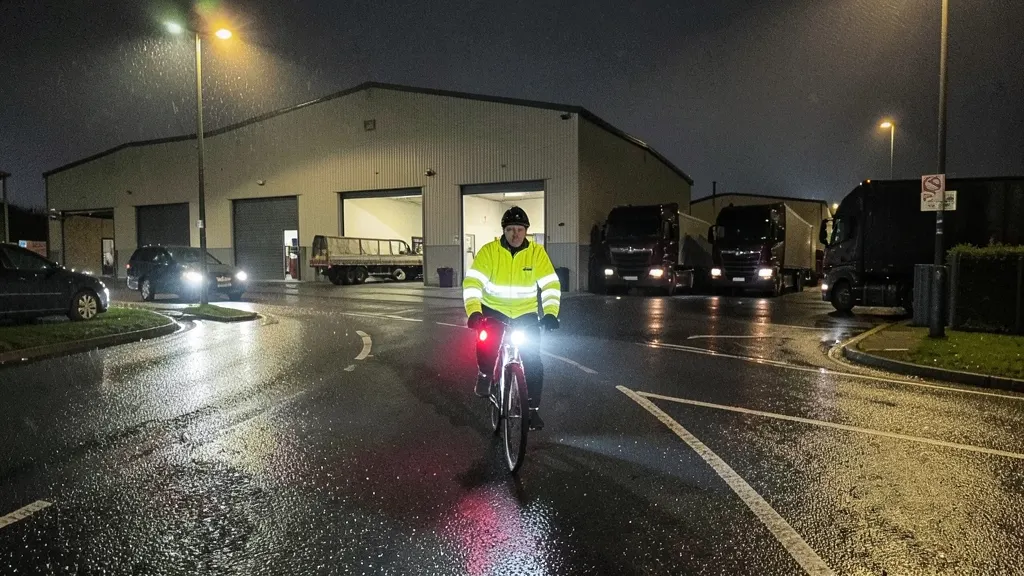
The moments when visibility matters most
Not every part of a commute carries the same risk. A few moments deserve particular attention.
The first is the transition at the end of the day. If you have been under strip lighting in a factory or office since morning, your eyes are not adapted for dark streets, and drivers coming off the same shift are in the same state. The first ten minutes of the journey home, especially crossing car parks or industrial access roads, is when a hi-vis jacket earns its keep.
The second is anywhere the road bends or dips. On rising ground, headlights point upwards and away from you, and a pedestrian or cyclist in dark clothing at the bottom of a dip can vanish. Downhill stretches have their own problem: traffic picks up speed, and braking distances grow on wet leaves or greasy tarmac.
The third is junctions and crossings near schools and shops in the early evening, where cars reverse out of side roads and drivers are watching other vehicles rather than people. And a fourth, easily forgotten: rain. Water on the road scatters headlight beams and cuts contrast, so a jacket that looked visible under a street lamp can fade into the general glare.
Kit that fits each moment
The Highway Code is clear on the basics. Rule 3 advises helping other road users to see you, noting that reflective materials such as sashes, waistcoats, jackets or footwear can be seen by drivers using headlights up to three times as far away as non-reflective materials. Rule 59 suggests fluorescent clothing helps in daylight and poor light, while reflective clothing or accessories such as belt, arm or ankle bands increase visibility in the dark. Our guide to what the highway code says about hi-vis covers this in more detail.
For the journey itself, match the garment to the moment:
- A winter hi vis jacket is the core item for Bradford commuters. Look for one with plenty of retroreflective banding, not just a strip or two, because the dark and the hills mean drivers get less warning time than they would on flat, lit roads.
- A waterproof hi vis jacket matters on wet evenings, when rain scatters light and reduces contrast. Some people keep a cheap packaway version in a bag for unexpected showers. Our piece on waterproof hi vis jackets: myths and facts explains what a coating actually does and what it does not.
- A fleece hi vis jacket suits anyone standing at a bus stop on a cold, exposed hillside road, and works well as a midlayer under a shell on the coldest days.
- A softshell hi vis jacket is a good middle option for walkers and motorcyclists who want warmth and stretch without a fully waterproof outer.
- Cyclists should follow Rule 60 as well: a lit white front light, a red rear light and a red rear reflector, with the jacket as a second line of defence. See our hi-vis jackets for cycling: a buyer's guide.
If your employer issues hi-vis at work, remember that under the Personal Protective Equipment at Work Regulations 1992 they must provide suitable PPE free of charge where there is a risk not controlled by other means, and since 6 April 2022 that duty extends to limb (b) workers too. HSE guidance also says reusable PPE must be cleaned regularly and kept in good condition, and workers must report any loss or obvious defect. A muddied jacket with worn-out reflective bands is not doing its job.
For a broader look at the whole season, from the clocks going back to the spring, read our winter commute visibility: a practical UK guide. We also have a full local page on hi-vis clothing in Bradford and advice on hi-vis for the school run for parents doing the dark drop-off.
The takeaway
Bradford's winter numbers do the arguing for you: sunset at 15:47 on the shortest day, and 123 days a year when a normal commute is partly in the dark. Add steep streets and wet weather and the conclusion is simple. Wear a proper winter hi vis jacket with generous reflective banding every time you travel after four o'clock, not just on the days it looks gloomy, and make sure your lights and reflectors are working too. If you are choosing a new one, our winter hi vis jackets: a practical buyer's guide walks through the options, including how reflective material actually works.
Frequently asked questions
What time does it get dark in Bradford in winter?
On the winter solstice, sunrise in Bradford is at 08:22 and sunset is at 15:47, giving 7 hours and 25 minutes of daylight. When the clocks go back on 25 October 2026, sunset that day is at 16:47. Anyone finishing work at five will be travelling home in the dark for much of the winter.
Is a waterproof hi vis jacket worth it for commuting?
Yes, and in Bradford the hills make it doubly useful. Rain scatters headlight beams and reduces contrast, which makes a reflective jacket less effective precisely when you need it. A waterproof hi vis jacket keeps you dry and visible, and some commuters keep a packaway version for unexpected showers.
Does the Highway Code say I have to wear hi-vis?
There is no legal requirement for ordinary commuters to wear hi-vis, but the Highway Code strongly advises it. Rule 3 says reflective materials can be seen by drivers using headlights up to three times as far away as non-reflective materials, and Rule 59 recommends reflective clothing or accessories for cyclists in the dark. Rule 60 does require cyclists to use lights at night.
What class of hi-vis should I look for?
EN ISO 20471 has three classes. Class 1 has a minimum of 0.14 m2 of fluorescent background material, class 2 has 0.50 m2 and class 3 has 0.80 m2, with correspondingly larger retroreflective areas. For commuting on busy roads in the dark, a higher class gives drivers more warning, and class 3 is the highest.
How should I look after a hi-vis jacket?
HSE guidance says reusable PPE must be cleaned and kept in good condition, and hi-vis jackets must be cleaned regularly. Dirt and grime dull both the fluorescent fabric and the reflective bands, so wash the jacket as the label instructs and replace it when the reflective strips stop shining under headlights.