Motorcycle hi vis jackets in Blackpool: what riders need
Last updated
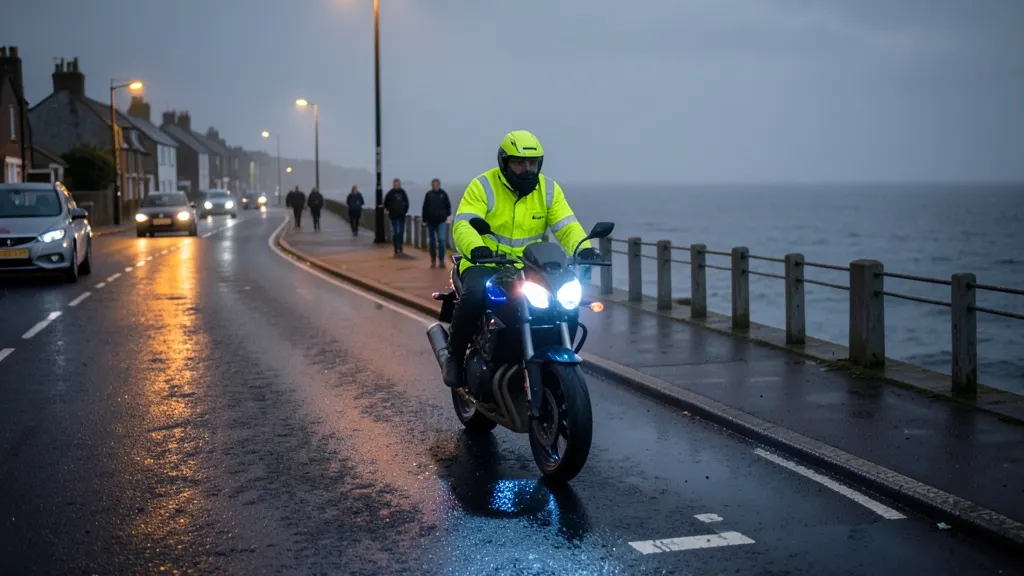
Riding a motorbike into Blackpool in winter means riding in the dark a lot of the time. In Blackpool there are 124 days a year when sunset comes before half past five in the evening or sunrise after quarter to eight in the morning, so a normal commute is partly in the dark. On the winter solstice the sun does not rise until 08:27 and it sets at 15:52, leaving just 7 hours and 24 minutes of daylight. Anyone commuting to or from this town of 141,000 people will spend a good chunk of the year relying on headlights rather than daylight.
The coastal setting adds its own problems. Blackpool sits on the Irish Sea coast of the Fylde peninsula, and that means glare, spray and flat grey light for much of the winter. The M55 motorway, built in 1975, made the town a realistic day trip destination, so traffic builds up at the same hours the light is failing. Motorcyclists are the road users who suffer most from being missed in those conditions, because a bike and rider present a narrow shape that is easy to lose against a backdrop of street lighting, illuminated attractions and queued traffic.
Why visibility matters more for riders here
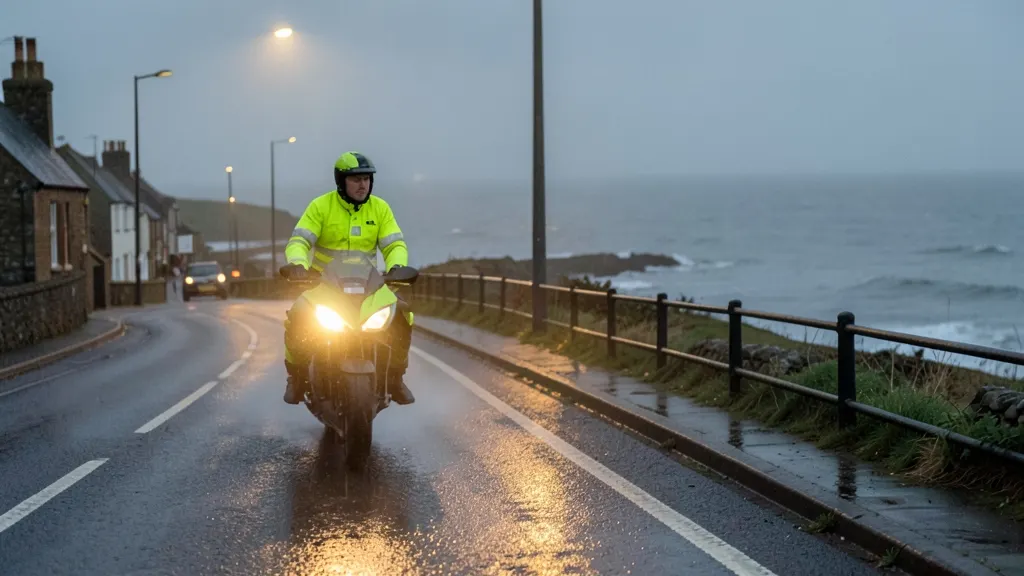
A car driver who fails to spot another car usually gets a dent. A driver who fails to spot a motorcyclist can cause a life changing injury. The Highway Code is blunt about the fix. Rule 86 says motorcyclists should make themselves as visible as possible from the side as well as the front and rear, for example with fluorescent clothing or strips. Rule 87 goes further for riding in the dark, saying riders should wear reflective clothing or strips to improve visibility.
Those two rules point at two different materials doing two different jobs. Fluorescent fabric works by converting ultraviolet light into visible light, so it stands out in daylight and poor daylight such as a grey overcast morning on the seafront. Retroreflective material works differently, bouncing light from headlamps straight back towards the driver. According to Rule 3 of the Highway Code, reflective materials such as jackets can be seen by drivers using headlights up to three times as far away as non-reflective materials. If you commute on the M55 or the local roads in Blackpool between October and March, that extra distance is the difference between a driver seeing you in time to react and seeing you too late. Our guide on how to be seen on a motorbike covers the full kit list, and we have a separate page on motorcycle hi vis jackets if you want more detail on the myths.
Choosing a hi vis motorbike jacket that actually works
A motorbike jacket has to protect you in a slide and keep you visible, and it has to do both while coping with sea air and winter rain. Start with the basics.
Fluorescent and reflective, not one or the other
If you ride in daylight, fluorescent yellow or orange background fabric gives you the strongest contrast against a grey coastal sky. If you ride in the dark, retroreflective bands are what get you seen. Most riders in Blackpool need both, because a single journey often starts in poor light and ends in full dark. On the day the clocks go back in 2026, 25 October, sunset in Blackpool is at 16:53, so plenty of people will be riding home in the dark a full two months before midwinter.
Waterproof matters as much as visible
Rain does two unhelpful things to visibility. It makes drivers peer through wet glass and judge distances badly, and it makes some riders hide under a dark waterproof layer that covers their bright one. A waterproof hi vis jacket solves that by combining the two, with sealed seams and reflective bands that stay effective when soaked. If your outer shell is black because you bought it before you thought about visibility, an over jacket in fluorescent fabric with reflective panels is a cheap way to fix it. See our winter hi vis jackets guide for more on cold weather layers.
Look for the standard
Garments sold as high visibility clothing in the UK should meet EN ISO 20471. The standard has three classes. Class 1 requires at least 0.14 m2 of fluorescent background material and 0.10 m2 of retroreflective material. Class 2 raises that to 0.50 m2 and 0.13 m2, and class 3, the highest, requires at least 0.80 m2 of fluorescent background and 0.20 m2 of retroreflective material. For a rider in Blackpool traffic, class 2 is a sensible minimum and class 3 gives the greatest amount of visible material. Check the label, not just the colour, because some casual yellow jackets fall short of the standard.
Fit and coverage
A jacket that flaps at speed or rides up over your back leaves gaps in the visible surface. Look for adjustable cuffs, a connecting zip for trousers, and reflective material around the arms as well as the chest. Rule 86 is specific about side visibility for a reason. Drivers pulling out from side roads mostly see you side on, and that is where a lot of motorcycle collisions begin.
Care and replacement
Hi vis material does not last forever. Fluorescent fabric fades with repeated washing and sun exposure, and reflective tape loses its performance once it is scuffed, cracked or regularly rubbed under a rucksack. Health and Safety Executive guidance on reusable PPE says hi vis garments must be cleaned regularly, kept in good condition, and that any obvious defect must be reported, and that is sensible advice for riders too even though the rules themselves apply to workers.
Practical habits make the jacket last longer. Wash it on a gentle cycle inside a pillowcase or wash bag, close the zips first, and skip fabric conditioner because it can coat reflective beads and dull them. Let it drip dry rather than putting it on a radiator, because heat degrades the reflective layer. Store it hanging rather than screwed into a pannier for weeks on end.
Inspect it before the clocks change each autumn. Hold it under a torch or car headlights in a dark shed and check that the bands still glow strongly from a distance. If the fabric has gone from vivid yellow to a washed out cream, or the tape has gone grey and smooth, replace it. A faded jacket gives a false sense of security, which is worse than no jacket at all because it stops you fixing the problem.
Blackpool's winter puts riders in the dark for a third of the year, on busy roads that carry day trip traffic alongside daily commuters. A proper hi vis motorbike jacket, kept clean and replaced when it wears out, is one of the cheapest safety upgrades a rider can make. If you also cycle the National Cycle Route 62 along the coast from Fleetwood to Lytham St Annes, our page on hi vis for cycling in Blackpool covers the rules for bikes, and our wider local guide to hi vis in Blackpool pulls it all together.
Frequently asked questions
Do motorcyclists legally have to wear hi vis in Blackpool?
No, there is no law requiring hi vis clothing for motorcyclists anywhere in the UK. The Highway Code is advisory here rather than mandatory. Rule 86 says riders should make themselves as visible as possible from the side as well as the front and rear, and Rule 87 says reflective clothing or strips should be worn when riding in the dark.
What hi vis class should a motorcycle jacket be?
EN ISO 20471 has three classes. Class 1 is the lowest, class 2 requires at least 0.50 m2 of fluorescent background material and 0.13 m2 of retroreflective material, and class 3 requires at least 0.80 m2 and 0.20 m2 respectively. For riding in Blackpool traffic, class 2 is a sensible minimum and class 3 gives the most visible material.
Is a fluorescent jacket enough for riding at night?
On its own, no. Fluorescent fabric works in daylight and poor light, but it does little under headlights at night. For riding in the dark you need retroreflective bands, which Rule 3 of the Highway Code says can be seen by drivers using headlights up to three times as far away as non-reflective materials. In Blackpool there are 124 days a year when a normal commute is partly in the dark, so most riders need both.
How should I wash a hi vis motorbike jacket?
Wash it regularly on a gentle cycle, ideally inside a wash bag, with the zips closed. Skip fabric conditioner because it can coat the reflective material and reduce its performance. Let the jacket drip dry away from direct heat, because radiators can damage the reflective tape. Check the care label first, as instructions vary.
How often should I replace my hi vis jacket?
There is no set period, so judge it by condition. If the fluorescent fabric has faded to a washed out shade or the reflective bands no longer glow strongly under headlights, replace it. Give it a torch test before the clocks go back each autumn, since riding in the dark soon follows, with sunset in Blackpool at 16:53 on 25 October 2026.