Hi-vis clothing in Blackpool
Last updated
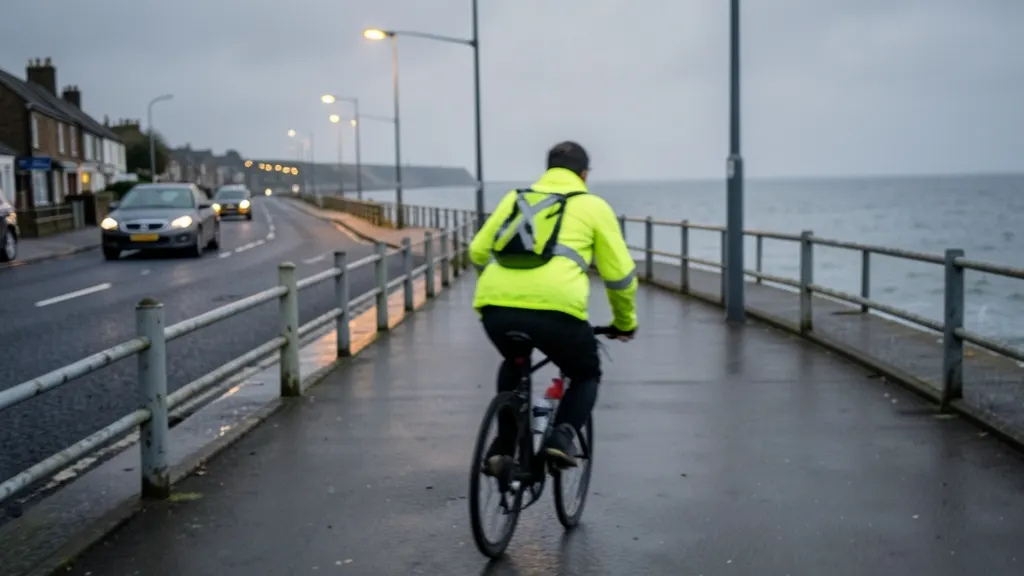
Blackpool sits on the Irish Sea coast of the Fylde peninsula, a seaside town of around 141,000 people whose economy still centres on tourism. Visitors arrive year round, many of them by road, and the town has a long history of getting people about: the Blackpool Tramway opened officially on 29 September 1885, and the M55 motorway, built in 1975, made day trips far easier. National Cycle Route 62 follows the coast on traffic-free paths from Fleetwood to Lytham St Annes via Blackpool, so plenty of people move around the town under their own power.
All of this movement, mixed with coastal weather, makes visibility a genuine concern here. The numbers tell the story. In Blackpool there are 124 days a year when sunset comes before half past five in the evening or sunrise after quarter to eight in the morning, so a normal commute is partly in the dark. On the winter solstice the sun rises at 08:27 and sets at 15:52, leaving just 7 hours and 24 minutes of daylight. When the clocks go back on 25 October 2026, sunset in Blackpool that day is at 16:53, right in the middle of the evening journey home.
There is a nice historical footnote too. Blackpool was the world's first municipality with electric street lighting, along the Promenade in 1879. A town that pioneered lighting its streets is a fitting place to think about lighting yourself up on them.
What this guide covers
This page is the hub for hi-vis advice specific to Blackpool. Three themed pages sit underneath it:
- Hi-vis for cycling and commuting in Blackpool looks at what riders on the seafront paths and town streets should wear, including the rules on lights and reflectors.
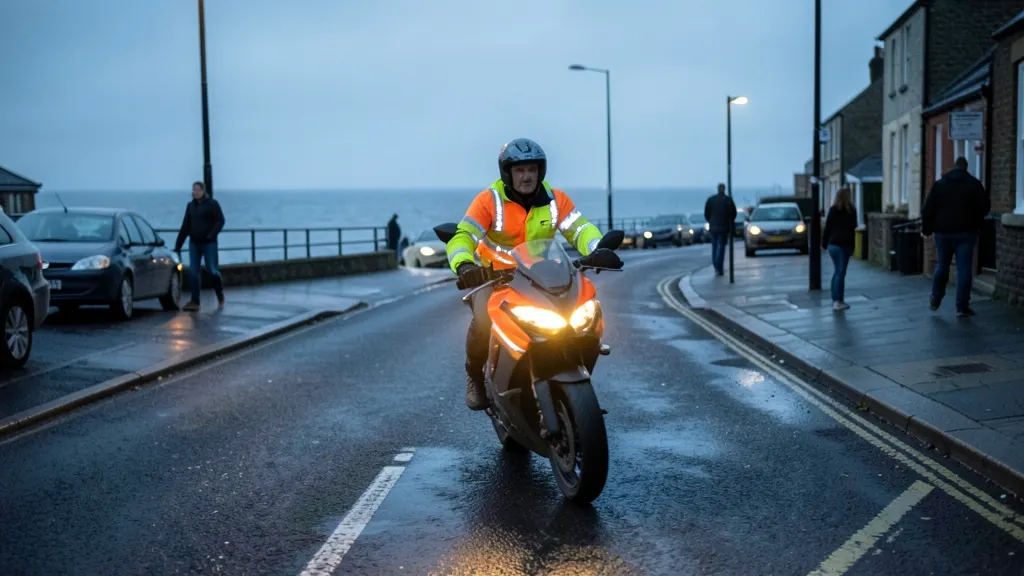
- Hi-vis for motorcyclists in Blackpool covers visibility for riders in a busy seaside resort that draws motorcyclists from across the region.
- Hi-vis for dark winter commutes in Blackpool tackles the short winter days and early sunsets that shape daily travel here.
Each page goes into more detail than this overview, so start with the one that matches how you travel.
Hi-vis guidance that applies whatever you ride or wear
A few principles carry across cycling, motorcycling and walking to work, and they are worth knowing before you buy anything.
Fluorescent material helps in daylight and poor light. Reflective material helps in the dark, when headlights are the main source of light. They do different jobs, which is why good hi-vis garments combine both. The Highway Code makes the distinction clearly. Rule 3 says reflective materials such as armbands, sashes, waistcoats, jackets or footwear can be seen by drivers using headlights up to three times as far away as non-reflective materials. Rule 59 adds that light-coloured or fluorescent clothing can help other road users see a cyclist in daylight and poor light, while reflective clothing or accessories such as belts, arm or ankle bands increase visibility in the dark.
If you are buying a jacket rather than a strip or band, it helps to know a little about the standard behind the labels. EN ISO 20471 has three classes, and the difference is simply how much visible material the garment contains. The minimum fluorescent background area is 0.14 square metres for class 1, 0.50 square metres for class 2 and 0.80 square metres for class 3. The minimum retroreflective area rises from 0.10 to 0.13 to 0.20 square metres across the same three classes. Class 3 is the highest, and if you ride or walk on fast or poorly lit roads it is the class worth aiming for.
Care matters as much as choice. Guidance from the Health and Safety Executive says reusable PPE must be cleaned and kept in good condition, and hi-vis jackets, trousers and coveralls must be cleaned regularly. That applies to everyday wearers too: dirt and grime dull both the fluorescent colour and the reflective bands, so a jacket that has gone grey in the wash is not doing its job. Check the reflective strips still bounce light back, and replace anything worn out rather than soldiering on with it.
Where to read next
Start with the theme that fits your journey:
- Cyclists and commuters on two pedal wheels should read Hi-vis for cycling and commuting in Blackpool.
- Riders on motorcycles will find what they need in Hi-vis for motorcyclists in Blackpool.
- Anyone travelling in the dark between late autumn and early spring should see Hi-vis for dark winter commutes in Blackpool.
If you want broader buying advice, Hi-vis jackets for cycling: a buyer's guide explains what to look for in a cycling jacket, and Winter hi vis jackets: a practical buyer's guide covers warmth and visibility together. If wet weather is your worry, and on this coast it often is, Waterproof hi vis jackets: myths and facts separates truth from marketing. You can also compare notes across the region on Hi-vis clothing in North West England.
Blackpool at a glance
- Nation: England
- Region: North West England
- Population: 141000
| Measure | Time |
|---|---|
| Sunrise on the winter solstice | 08:27 |
| Sunset on the winter solstice | 15:52 |
| Daylight on the winter solstice | 7h 24m |
| Sunset when the clocks go back (2026-10-25) | 16:53 |
| Days a year with a dark commute | 124 |
Frequently asked questions
Do I legally have to wear a hi-vis jacket in Blackpool?
There is no law requiring everyday cyclists, pedestrians or motorcyclists in Blackpool to wear hi-vis. The Highway Code advises it, for example Rule 17 says to wear something reflective at night, but advice is not the same as a legal requirement. Employers do have duties under the Personal Protective Equipment at Work Regulations 1992 to provide suitable PPE to workers exposed to a risk, and since 6 April 2022 that duty extends to limb (b) workers with the PPE provided free of charge.
How dark does it actually get on a Blackpool commute in winter?
On the winter solstice in Blackpool the sun rises at 08:27 and sets at 15:52, giving only 7 hours and 24 minutes of daylight. When the clocks go back on 25 October 2026, sunset that day is at 16:53. There are 124 days a year in Blackpool when sunset comes before half past five in the evening or sunrise after quarter to eight in the morning.
What does class 3 mean on a hi-vis jacket?
EN ISO 20471 has three classes, and class 3 is the highest. A class 3 garment needs at least 0.80 square metres of fluorescent background material and 0.20 square metres of retroreflective material. It offers the most coverage, which is why it suits fast roads and dark conditions.
Do cyclists in Blackpool need lights as well as reflective clothing?
Yes. Rule 60 of the Highway Code says that at night a cycle must have white front and red rear lights lit, plus a red rear reflector. Reflective clothing adds to your visibility but it does not replace the legal lighting requirements.
Should motorcyclists wear hi-vis or is it a myth that it helps?
The Highway Code is clear that visibility helps. Rule 86 says motorcyclists should make themselves as visible as possible from the side as well as the front and rear, for example with fluorescent clothing or strips. Rule 87 says that when riding in the dark they should wear reflective clothing or strips to improve visibility. Our motorcycle myths page covers the common objections.