Hi-vis for dark winter commutes in Belfast
Last updated
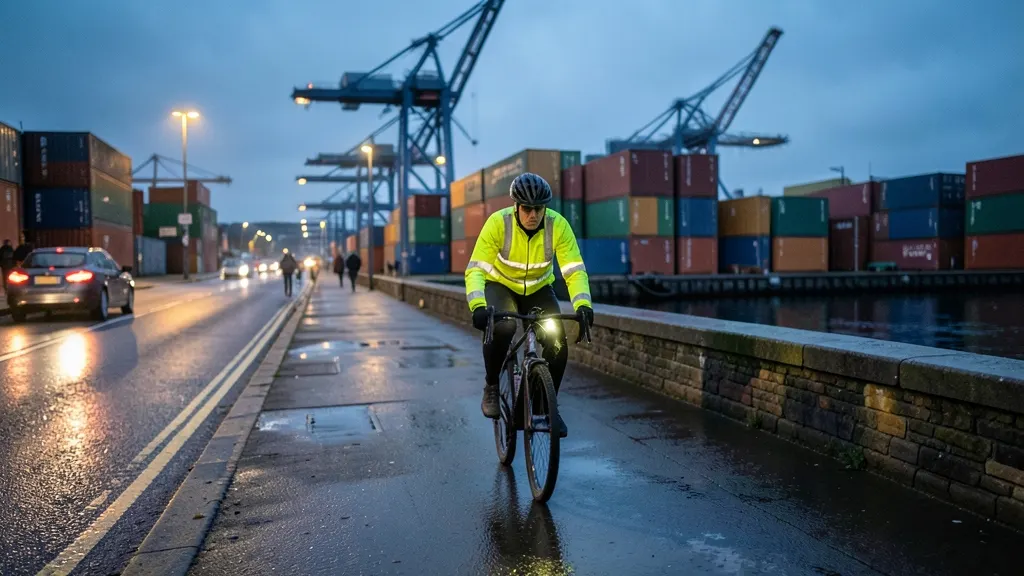
A day in the life of a Belfast winter commute starts early. On the winter solstice, sunrise in Belfast is not until 08:44 and sunset follows at 15:59, giving just 7h 15m of daylight. That means most people leave home in the dark and travel home in it too. Across the year there are 126 days in Belfast when sunset comes before half past five in the evening or sunrise after quarter to eight in the morning, so for a large share of the working year a normal commute is at least partly in the dark.
Morning begins with streetlights still on. Perhaps you walk from home to a bus stop, or cycle along the towpath that runs from the city-centre quayside to Lisburn through the Lagan Valley Regional Park, or along the Connswater Community Greenway and the Comber Greenway in the east of the city. The M1 motorway to Dublin and the west, and the Westlink, carry a steady stream of headlights past the city, and the docks and industrial sites around the port never fully stop. By half past four the light is already fading, and by five you are riding or walking in full darkness with rain likely on your face.
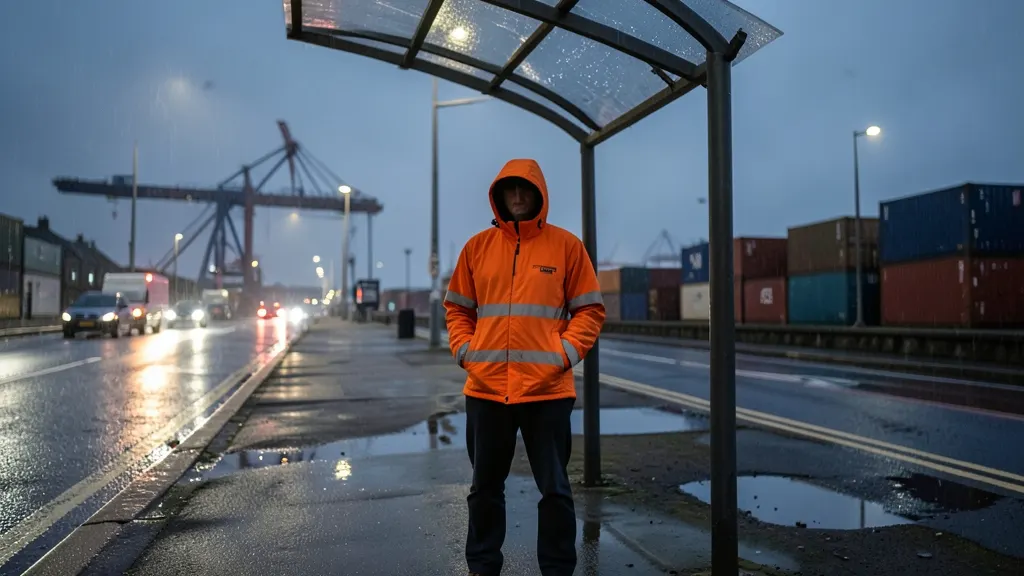
Moments where visibility matters most
The risky moments on a winter commute in Belfast are the ones where drivers have the least time to see you.
- The first stretch from your door to the main road, where cars are moving quickly out of side streets.
- Crossing or joining traffic on or near the M1 and the Westlink, where speeds are high and spray hides everything.
- Shared paths such as the towpath and the greenways, where cyclists, walkers and dog walkers share the same space in low light.
- Roundabouts and junctions on the way into the Harbour Estate, where lorries serving the port have large blind spots.
- The final walk from the bus stop home, often the darkest and quietest leg of the day.
The Highway Code is plain about this. Rule 3 says to help other road users to see you, and notes that reflective materials such as armbands, sashes, waistcoats, jackets or footwear can be seen by drivers using headlights up to three times as far away as non-reflective materials. Rule 59 tells cyclists that fluorescent clothing helps in daylight and poor light, while reflective clothing or accessories such as belts, arm or ankle bands increase visibility in the dark.
Kit that fits each moment
One jacket rarely covers every leg of the journey, so think about what each part of the day needs.
The walk to the bus or the school run
A waterproof hi vis jacket with a hood works well here. Belfast winter rain arrives sideways, and a yellow or orange fluorescent shell keeps you dry and visible to drivers. A class 2 garment under EN ISO 20471, with at least 0.50 m2 of fluorescent background material and 0.13 m2 of retro reflective material, is a sensible level for walking near traffic.
The cycle along the towpath or greenway
Cyclists have legal duties as well as practical ones. Rule 60 says that at night a cycle must have white front and red rear lights lit, and a red rear reflector. Rule 69 requires cyclists to obey all traffic signs and traffic light signals. Reflective jackets help, and ankle bands move as you pedal, which catches drivers' eyes. Our guide to hi-vis jackets for cycling goes into more detail, and Rule 59's advice on reflective accessories is worth rereading before the clocks go back.
Standing at the roadside waiting
Waiting in the dark and rain is where cheap jackets fail. A fleece hi vis jacket or a softshell hi vis jacket keeps the warmth in while you stand still, and the softshell type breathes better if you have hurried to the stop. If you want the reflective strips explained, our guide to how reflective material works covers the basics.
Driving or riding the last stretch
Motorcyclists get specific advice in the Highway Code. Rule 86 says riders should make themselves as visible as possible from the side as well as the front and rear, for example with fluorescent clothing or strips, and Rule 87 says that when riding in the dark they should wear reflective clothing or strips. Drivers who work in the docks, the shipyard or around the airports at Belfast City Airport and Belfast International Airport may find that their employer supplies hi-vis under the Personal Protective Equipment at Work Regulations 1992, which require suitable PPE for workers exposed to a health or safety risk, provided free of charge.
Care of your kit
Hi-vis only works if it stays clean. HSE guidance says reusable PPE must be cleaned and kept in good condition, and that hi-vis jackets, trousers and coveralls must be cleaned regularly, with workers reporting any loss, destruction or obvious defect. Road grime on reflective strips cuts their performance, so wash your jacket when it goes grey.
Wrapping up
Belfast gives you short days, regular rain and a lot of movement around a working port, so visibility is not a nice extra, it is part of the commute. The clocks go back on 25 October 2026, when sunset in Belfast falls at 17:02, so plan ahead rather than waiting for the shock of the first dark afternoon. For choosing a jacket, our winter hi vis jackets buyer's guide covers warmth, waterproofing and standards, our page on waterproof hi vis jackets sorts myths from facts, and hi-vis clothing in Belfast gathers local guidance in one place.
The one takeaway: pick a jacket that matches the darkest and wettest leg of your journey, not the shortest one, and keep it clean.
Frequently asked questions
When does it get dark in Belfast during winter?
On the winter solstice in Belfast, sunrise is at 08:44 and sunset is at 15:59, giving just 7h 15m of daylight. There are 126 days a year in Belfast when sunset comes before half past five in the evening or sunrise after quarter to eight in the morning. This means a typical commute is partly in the dark for a large share of the year.
What hi vis class should a commuter jacket be?
For walking or cycling near traffic, a class 2 garment under EN ISO 20471 is a sensible choice, with at least 0.50 m2 of fluorescent background material and 0.13 m2 of retroreflective material. Class 3 is the highest class, with at least 0.80 m2 of fluorescent material and 0.20 m2 of retroreflective material. Higher-risk settings such as working around the port or motorways call for class 3.
Does a waterproof hi vis jacket lose visibility in the rain?
Reflective strips still work in wet weather, but road grime and dirt reduce their performance over time, so regular cleaning matters. HSE guidance says hi-vis jackets must be cleaned regularly and kept in good condition. A dirty jacket looks grey in headlights well before it looks grey to you.
Do I legally need reflective clothing when cycling at night in Belfast?
The Highway Code requires cycle lights, not reflective clothing. Rule 60 says a cycle must have white front and red rear lights lit at night, plus a red rear reflector. Rule 59 advises fluorescent clothing for daylight and poor light, and reflective clothing or accessories for the dark, so a reflective jacket is strongly recommended even though it is not a legal requirement.
Should my employer provide my hi-vis jacket?
Under the Personal Protective Equipment at Work Regulations 1992, employers must provide suitable PPE to workers exposed to a health or safety risk, unless the risk is adequately controlled by other means. Since 6 April 2022 these duties also cover limb (b) workers, and the employer must provide the PPE free of charge.