Hi-vis clothing in Stirling: a practical local guide
Last updated
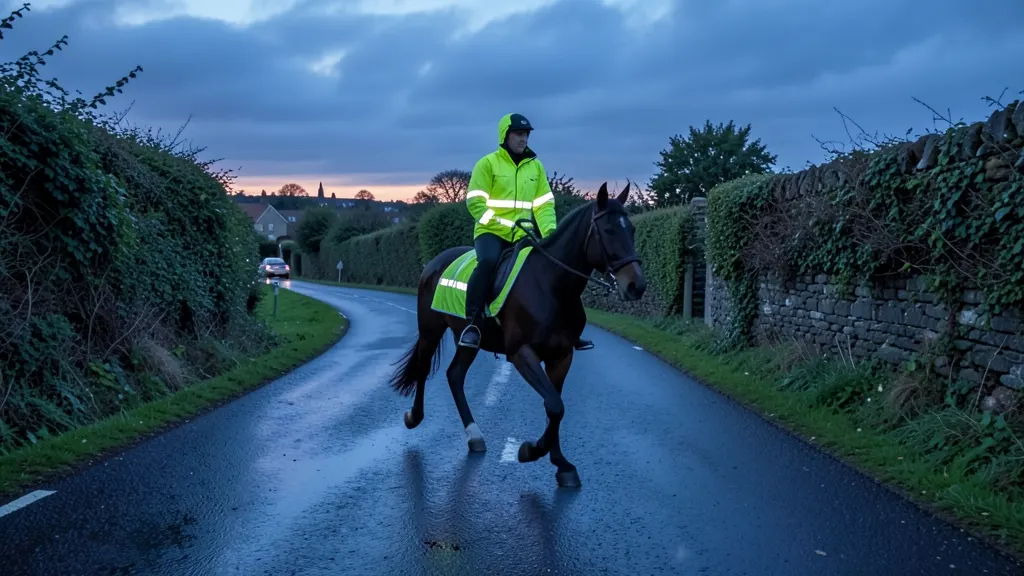
Stirling sits on the River Forth at the lowest bridging point before the river broadens towards the Firth of Forth. It is the administrative centre for the Stirling council area and traditionally the county town of Stirlingshire, with a settlement population of 49,928 at the 2022 census. Modern Stirling is a centre for local government, higher education, tourism, retail and industry, so on any given day the roads carry commuters, students, delivery drivers, cyclists, riders and walkers.
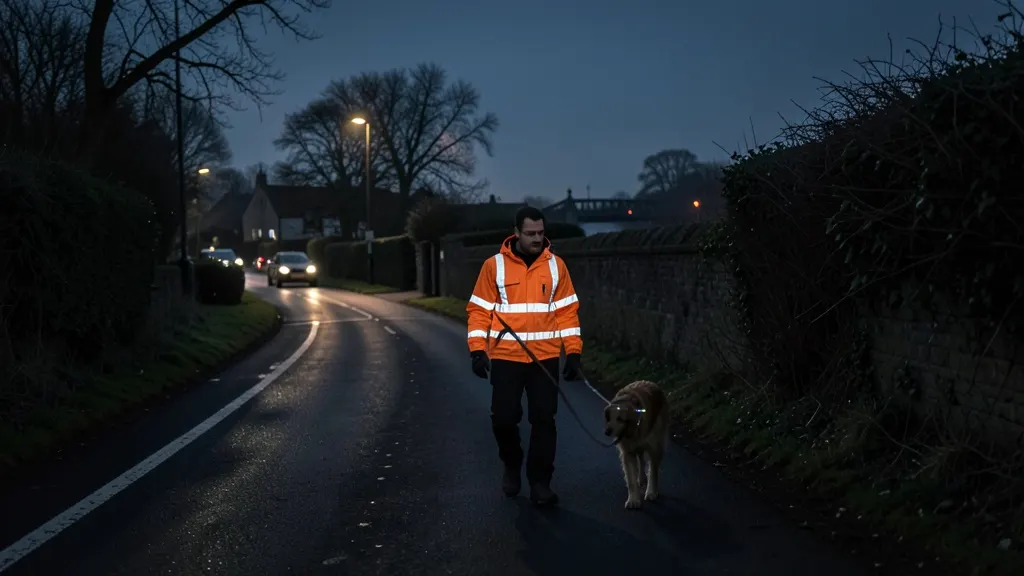
Why visibility matters here
Stirling's latitude makes itself felt in winter. On the winter solstice, sunrise is at 08:46 and sunset at 15:41, giving just 6 hours and 55 minutes of daylight. There are 128 days a year when sunset comes before half past five in the evening or sunrise after quarter to eight in the morning, which means a normal commute is partly in the dark. When the clocks go back on 25 October 2026, sunset in Stirling that day is at 16:50, and from that point onwards an afternoon walk or ride in poor light is a regular reality rather than an exception.
The surrounding geography adds to the mix. The University of Stirling campus occupies the historic Airthrey estate, about 360 acres (145 hectares) in the foothills of the Ochil Hills, and includes Airthrey Loch. Gillies Hill and the King's Park prehistoric carvings lie south of the city. The M80 to Glasgow and the M9 to Edinburgh and north to Dunblane bring fast traffic close to the town, while rural roads, tracks and riverside paths carry a steady flow of walkers, riders and runners. Poor light, mixed traffic and exposed terrain are exactly the conditions where hi-vis clothing earns its keep.
What this hub covers
This page introduces three common situations where Stirling residents need to be seen, with a dedicated guide for each:
- Hi-vis for horse riding in Stirling, for riders on the rural roads and tracks around the town.
- Hi-vis for dog walking in Stirling, for riverside paths and the nearby hills.
- Running on campus and riverside paths, where early darkness in winter catches many people out.
For the wider picture, including how Scottish conditions affect clothing choice generally, see our guide to hi-vis clothing in Scotland.
General hi-vis guidance that applies across themes
A few principles hold true whatever you are doing outdoors around Stirling.
Fluorescent for daylight, reflective for the dark. Fluorescent colours work by converting ultraviolet light into visible glow, so they shine in daylight and poor light such as dusk, overcast weather and rain. They do very little in true darkness. Retroreflective material bounces light from headlights straight back at drivers, which is why the Highway Code (Rule 3) says reflective materials such as armbands, sashes, waistcoats, jackets or footwear can be seen by drivers using headlights up to three times as far away as non-reflective materials. For dog walkers and runners this is the single most useful fact: an orange or yellow jacket helps at 3pm, but the reflective bands are what saves you at 6pm.
Movement catches the eye. Reflective strips placed at joints such as wrists and ankles move as you walk or run, and the flicker is more noticeable to a driver than a static panel. This applies to runners swinging their arms, dog walkers throwing a ball, and riders whose leg reflectors move with the horse. If your budget only stretches to one accessory, ankle bands are often the best value.
Check what your jacket actually is. A bright garment is not automatically a hi-vis garment. The standard EN ISO 20471 has three classes, with a minimum fluorescent background area of 0.14 m2 for class 1, 0.50 m2 for class 2 and 0.80 m2 for class 3, and minimum retroreflective areas of 0.10, 0.13 and 0.20 m2 respectively. Class 3 is the highest, and is what you should look for if you regularly ride on fast rural roads, where drivers have less time to react. Many casual jackets sold as bright or sporty carry no standard at all, and there is nothing wrong with that as long as you know what you are buying.
Look after it. Dirt kills both fluorescent brightness and retroreflective performance. Guidance from the Health and Safety Executive on workplace PPE applies equally to your own kit: keep hi-vis garments clean, check reflective strips for wear, and replace anything where the tape has cracked or peeled. A grey, washed-out jacket that once fluoresced brightly may give a fraction of its original performance.
Layer for Scottish weather. A hi-vis jacket that soaks through stops being worn, which is the most common failure mode of all. Pair visibility with waterproofing and warmth, and see our guides on waterproof hi vis jackets and winter hi vis jackets for detail.
Where to read next
Each activity around Stirling has its own risks and its own best kit:
- Riders should read our local guide to hi-vis for horse riding in Stirling alongside the general buyer's guide to hi-vis jackets for horse riding, which covers rider and horse kit together.
- Dog walkers will find sensible comparisons in hi-vis jackets for dog walking, including advice for off-lead dogs in low light.
- Runners can compare jacket types in hi-vis jackets for running.
Whatever you choose, the goal is the same: make sure the driver coming round that wet bend at half past four sees you in plenty of time.
Stirling at a glance
- Nation: Scotland
- Region: Scotland
- Population: 49928
| Measure | Time |
|---|---|
| Sunrise on the winter solstice | 08:46 |
| Sunset on the winter solstice | 15:41 |
| Daylight on the winter solstice | 6h 55m |
| Sunset when the clocks go back (2026-10-25) | 16:50 |
| Days a year with a dark commute | 128 |
Frequently asked questions
What class of hi-vis jacket do I need for riding around Stirling?
For riding on fast or rural roads, look for class 3 under EN ISO 20471, which is the highest class and requires at least 0.80 m2 of fluorescent background material and 0.20 m2 of retroreflective material. For tracks and quieter lanes, class 2 is a reasonable minimum. Many riders also add reflective leg bands to their horse, since moving reflectors catch a driver's eye faster than a static panel.
How dark does Stirling actually get in winter?
Very dark by UK standards. On the winter solstice, sunrise in Stirling is at 08:46 and sunset at 15:41, giving 6 hours and 55 minutes of daylight. There are 128 days a year when sunset comes before half past five in the evening or sunrise after quarter to eight in the morning, so many commutes are partly in the dark.
Is a bright jacket enough for dog walking in the evening?
Not on its own. Fluorescent colours work well in daylight and poor light but do little in true darkness. Reflective strips and bands are what drivers see in headlights, and the Highway Code notes that reflective materials can be seen up to three times further away than non-reflective ones. Choose a jacket with decent reflective taping and add an LED clip light if you walk unlit riverside paths.
Do runners need hi-vis or just lights?
Both work best together. A hi-vis jacket makes you visible from the side and in headlights, while a small light makes you visible even where headlights are not aimed at you. Reflective detail at the wrists and ankles helps drivers judge your movement. On dark mornings, avoid dark leggings with no reflective piping, since a bright top and invisible legs still leave you half unseen.
How do I keep my hi-vis jacket working properly?
Wash it regularly, because dirt and grime reduce both fluorescence and reflectivity. Check the reflective tape for cracking or peeling after repeated washing, and replace the jacket once the tape degrades. Follow the care label, skip fabric conditioner where the label advises it, and store the jacket away from direct sunlight when not in use.