Hi-vis clothing in Peterborough
Last updated
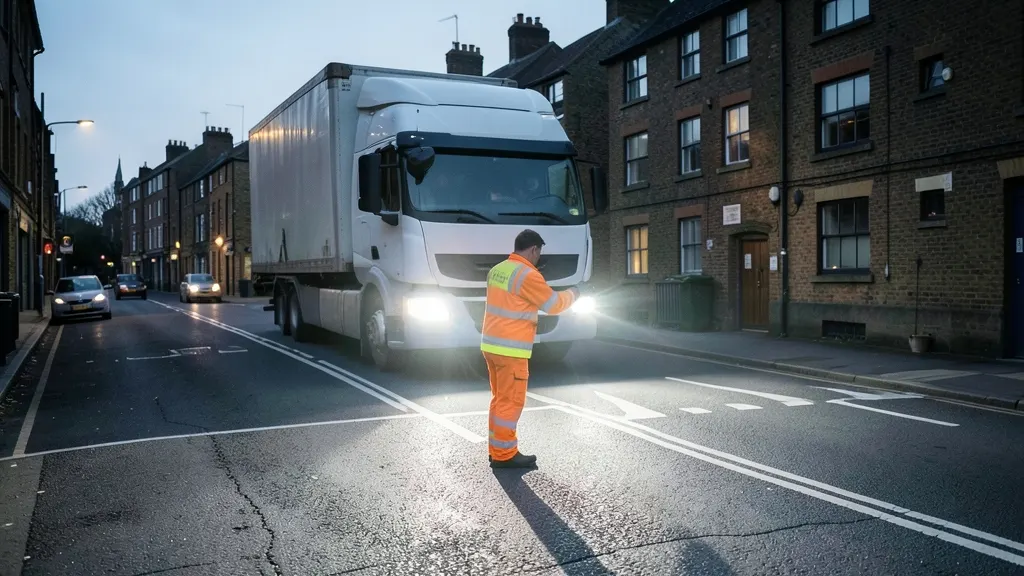
Peterborough is a city in the East of England with a population of 192,178 in its urban area, according to the 2021 census. Its economy was built on transport and making things: the arrival of the Great Northern Railway's line from London to York in 1850 turned a market town into an industrial centre, and the area was the UK's leading producer of bricks for much of the twentieth century. Today the main economic sectors are financial services and distribution, and distribution in particular means a lot of people spend their working day in yards, at loading bays and around moving vehicles.
Visibility matters here for a simple reason: the winter days are short. On the winter solstice in Peterborough the sun rises at 08:09 and sets at 15:48, giving just 7 hours 39 minutes of daylight. There are 122 days a year when sunset comes before half past five in the evening or sunrise comes after quarter to eight in the morning, so a normal commute is partly in the dark. The clocks go back on 25 October 2026, and sunset that day in Peterborough is at 16:44, right in the middle of the evening rush home. A good hi vis jacket is therefore not a seasonal extra but something worth wearing for a large part of the year.
What this guide covers
We have split our Peterborough advice into themed pages so you can go straight to what applies to you.
If you work outdoors or in a yard, see our page on hi-vis for work and site wear in Peterborough. Distribution remains one of the city's main sectors, so plenty of local jobs involve forklifts, lorries and night or early shifts.
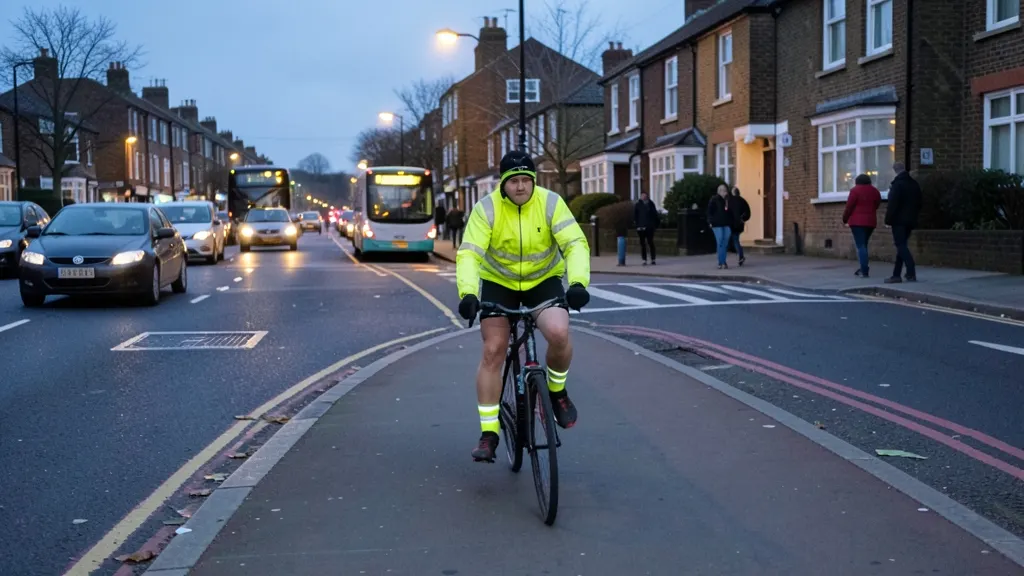
If you get around by bike, start with our page on hi-vis for cycling and commuting in Peterborough. The city is famously flat, and there is a 50-mile (80 km) network of cycleways, footpaths and bridleways around the city, with continuous circular routes and radiating spokes to the city centre, which makes riding to work a realistic option for many people.
If you walk children to school, our page on hi-vis for the school run and children in Peterborough covers what helps on grey mornings and dark afternoons.
General guidance that applies to all of them
Whatever you are doing, the same principles hold.
Fit the standard to the job. EN ISO 20471 has three classes. Minimum fluorescent background area is 0.14 m2 for class 1, 0.50 m2 for class 2 and 0.80 m2 for class 3, with minimum retroreflective areas of 0.10, 0.13 and 0.20 m2 respectively. Class 3 is the highest class and is what you want for fast traffic, poor lighting or night work. A class 2 jacket suits many yard and depot roles.
Know what your employer must provide. Under the Personal Protective Equipment at Work Regulations 1992, employers must ensure suitable PPE is provided to workers exposed to a risk to their health or safety, unless the risk is adequately controlled by other means. Since 6 April 2022 these duties also cover limb (b) workers, and the employer must provide the PPE free of charge.
Check for railway work. SATRA, a UK PPE testing body, states that rail standard RIS-3279-TOM requires an orange colour and garments meeting at least class 2 of EN ISO 20471. If your role touches the railway, ask before you buy a yellow jacket.
Look after it. HSE guidance says reusable PPE must be cleaned and kept in good condition, and hi-vis jackets, trousers and coveralls must be cleaned regularly. Workers must report any loss, destruction or obvious defect. A jacket caked in grime reflects far less light than a clean one, so washing it is part of staying visible, not vanity.
Follow the Highway Code. Rule 3 advises helping other road users to see you: in the dark, use reflective materials such as armbands, sashes, waistcoats, jackets or footwear, which drivers using headlights can see up to three times as far away as non-reflective materials. Rule 59 says fluorescent clothing helps in daylight and poor light, while reflective belts, arm or ankle bands increase visibility in the dark. Rule 60 requires a white front light and red rear light, plus a red rear reflector, on any cycle used at night.
Where to read next
For broader guidance, our regional page on hi-vis clothing in East of England sets Peterborough in context. If you are choosing a jacket for work, high visibility clothing workwear: choosing a hi vis jacket explains the classes in practice. Because much of the commuting year here is wet or dark, waterproof hi vis jackets: myths and facts and winter hi vis jackets: a practical buyer's guide are worth a read before you buy. Cyclists should see hi-vis jackets for cycling: a buyer's guide, and parents can compare claims in kids hi vis jackets: myths and facts.
Peterborough at a glance
- Nation: England
- Region: East of England
- Population: 192178
| Measure | Time |
|---|---|
| Sunrise on the winter solstice | 08:09 |
| Sunset on the winter solstice | 15:48 |
| Daylight on the winter solstice | 7h 39m |
| Sunset when the clocks go back (2026-10-25) | 16:44 |
| Days a year with a dark commute | 122 |
Frequently asked questions
What class of hi vis jacket do I need for yard or depot work in Peterborough?
For most yard and warehouse roles, a jacket meeting class 2 of EN ISO 20471 is the common choice, with at least 0.50 m2 of fluorescent background material and 0.13 m2 of retroreflective material. For fast traffic, night work or poor lighting, class 3 is the higher option, with at least 0.80 m2 of fluorescent material and 0.20 m2 of retroreflective material. If your work touches the railway, SATRA states that rail standard RIS-3279-TOM requires an orange colour and at least class 2.
Does my employer have to supply my hi-vis jacket?
Under the Personal Protective Equipment at Work Regulations 1992, employers must provide suitable PPE to workers exposed to a health or safety risk, unless the risk is adequately controlled by other means. Since 6 April 2022 the duties also cover limb (b) workers, and the employer must provide the PPE free of charge. If you are unsure, ask before buying your own.
How much of the Peterborough year is spent commuting in the dark?
There are 122 days a year when sunset comes before half past five in the evening or sunrise comes after quarter to eight in the morning. On the winter solstice, sunrise is at 08:09 and sunset is at 15:48, giving 7 hours 39 minutes of daylight. That means a hi vis jacket earns its keep across a fair stretch of the year.
Is a fluorescent jacket enough for cycling at night?
Fluorescent material works well in daylight and poor light, but in the dark it is reflective material that counts. Rule 59 of the Highway Code recommends reflective clothing or accessories such as belts, arm or ankle bands after dark, and Rule 60 requires a white front light, a red rear light and a red rear reflector on the bike itself. Combine the two for the best result.
How do I keep a hi-vis jacket working properly?
HSE guidance says reusable PPE must be cleaned and kept in good condition, and hi-vis jackets, trousers and coveralls must be cleaned regularly. Workers must report any loss, destruction or obvious defect. Dirt and wear reduce both fluorescence and reflectance, so regular washing and prompt replacement of damaged kit keep you visible.