Staying visible in Oxford
Last updated
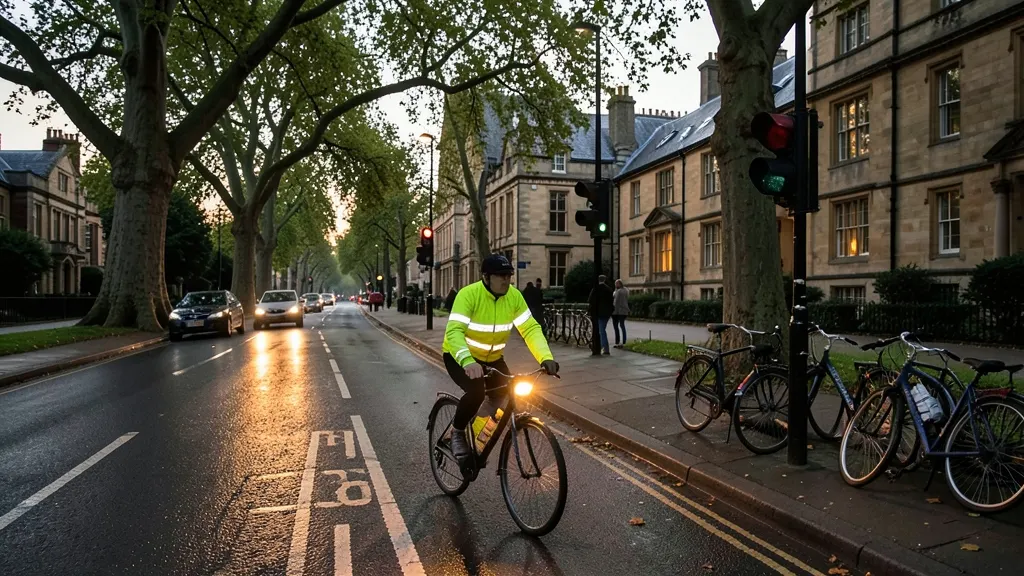
Oxford sits in South East England and is home to around 165,940 people (2025 estimate). It is best known as the home of the University of Oxford, the oldest university in the English-speaking world, and its streets reflect that. Alongside the university, the city supports manufacturing, publishing and science-based industries, which means a steady mix of staff, students, commuters and shift workers moving about at all hours.
What makes visibility a real issue here is the light, or the lack of it. On the winter solstice in Oxford, sunrise is at 08:09 and sunset is at 15:56, giving just 7 hours and 47 minutes of daylight. Across the year there are 119 days when sunset comes before half past five in the evening or sunrise after quarter to eight in the morning, so a normal commute is partly in the dark. The clocks go back on 25 October 2026, when sunset in Oxford is at 16:50, and from that point the evening journey home is a low-light one. A good hi vis jacket stops being an optional extra and becomes part of the daily routine.
Cycling and commuting
Among cities in England and Wales, Oxford has the second highest percentage of people cycling to work. That tells you most of what you need to know about how the city moves. Staff and students cross the city by bike every day, often in the dark or in wet, grey conditions. The Highway Code is clear on this. Rule 59 says light-coloured or fluorescent clothing helps other road users see a cyclist in daylight and poor light, while reflective clothing or accessories such as belts, arm bands or ankle bands increase visibility in the dark. Rule 60 requires a white front light, a red rear light and a red rear reflector at night, and Rule 3 notes that reflective materials such as armbands, sashes, waistcoats, jackets or footwear can be seen by drivers using headlights up to three times as far away as non-reflective materials.
If you cycle to work in Oxford, a class 2 or class 3 garment under EN ISO 20471 gives you a generous area of fluorescent background material plus retroreflective bands, and the difference on a rainy evening is obvious. For more detail on choosing a jacket and matching it to your lights, see Hi-vis for cycling and commuting in Oxford and the general Hi-vis jackets for cycling: a buyer's guide.
Running
Oxford has plenty of green space for runners. Port Meadow is a large meadow of open common land beside the Thames, popular for walking, running and cycling. University Parks is a parkland area of around 74 acres northeast of the city centre, along the River Cherwell. The Thames Path, a 185 mile National Trail following the River Thames, also passes through the area. In winter, much of that running happens before sunrise or after sunset. Rule 17 of the Highway Code is direct: at night, wear something reflective to make it easier for others to see you. A lightweight, breathable hi vis running jacket with reflective detailing is the sensible choice, and Hi-vis jackets for running: how to choose covers what to look for.
Dog walking
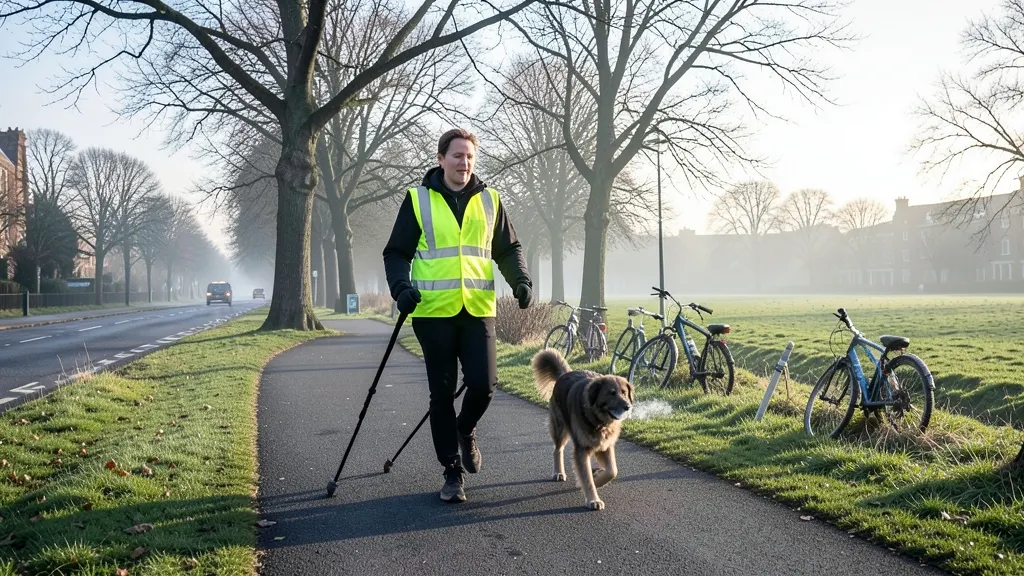
Port Meadow and the riverside paths are well used by dog walkers, including many people who head out after work when light has gone. This is where a hi vis jacket earns its keep, for two reasons. First, it makes you visible to cyclists on shared paths. Second, reflective detailing on your clothing can help you keep sight of your own position on unlit ground, and a reflective band on the dog helps you spot it too. See Hi-vis for dog walking in Oxford and Hi-vis jackets for dog walking: how to choose for more.
Guidance that applies whatever you are doing
Whatever the activity, the same principles hold in Oxford.
- Fluorescent for daylight, reflective for the dark. Fluorescent yellow and orange work well in daylight and poor light, but they do little at night without a light source. Retroreflective material returns light from headlights and street lighting, which is why the Highway Code recommends both.
- Match the class to your use. EN ISO 20471 has three classes. Class 1 has a minimum fluorescent background area of 0.14 m2 and 0.10 m2 of retroreflective material, class 2 has 0.50 m2 and 0.13 m2, and class 3 has 0.80 m2 and 0.20 m2. Class 3 is the highest, and it suits fast or high-risk roads. For most Oxford cycling and dog walking, class 2 is a reasonable everyday choice.
- Cover the moving parts. Reflective ankle bands catch drivers' eyes because they move as you pedal or stride. Rule 86 makes the same point for motorcyclists, who should make themselves as visible as possible from the side as well as the front and rear.
- Keep it clean. HSE guidance says reusable PPE must be cleaned and kept in good condition, and hi-vis jackets, trousers and coveralls must be cleaned regularly. A grubby fluorescent jacket is far less effective than a clean one.
- Layer for the weather. Rain reduces visibility for everyone and Oxford winters are wet. Waterproof hi vis jackets: myths and facts and Winter hi vis jackets: a practical buyer's guide will help you choose gear that works in poor conditions.
If your employer requires hi-vis at work, it is worth knowing the law. Under the Personal Protective Equipment at Work Regulations 1992, employers must provide suitable PPE to workers exposed to a risk to health or safety unless the risk is controlled by other means. Since 6 April 2022 those duties also cover limb (b) workers, and the employer must provide the PPE free of charge.
Where to read next
To place Oxford in its wider setting, Hi-vis clothing in South East England: a regional guide covers the whole region. For the themed Oxford pages, start with Hi-vis for cycling and commuting in Oxford and Hi-vis for dog walking in Oxford.
Oxford at a glance
- Nation: England
- Region: South East England
- Population: 165940
| Measure | Time |
|---|---|
| Sunrise on the winter solstice | 08:09 |
| Sunset on the winter solstice | 15:56 |
| Daylight on the winter solstice | 7h 47m |
| Sunset when the clocks go back (2026-10-25) | 16:50 |
| Days a year with a dark commute | 119 |
Frequently asked questions
What class of hi-vis jacket should I wear for cycling in Oxford?
For most city cycling, a class 2 garment under EN ISO 20471 is a sensible everyday choice, with at least 0.50 m2 of fluorescent background material and 0.13 m2 of retroreflective material. Class 3 is the highest class, with at least 0.80 m2 of fluorescent material and 0.20 m2 of retroreflective material, and suits faster or riskier roads. Always pair your jacket with the lights required by Rule 60: a white front light, a red rear light and a red rear reflector at night.
How dark does Oxford get in winter?
On the winter solstice, sunrise in Oxford is at 08:09 and sunset is at 15:56, giving 7 hours and 47 minutes of daylight. There are 119 days a year when sunset comes before half past five in the evening or sunrise after quarter to eight in the morning, so a normal commute is partly in the dark.
Do I need hi-vis for dog walking on Port Meadow?
Yes, it is worth wearing it, especially in the darker months. Port Meadow is shared with cyclists, and Rule 17 of the Highway Code advises wearing something reflective at night so others can see you. A class 2 jacket or a reflective vest over a warm coat works well, and a reflective band on your dog helps you keep track of it too.
Does reflective clothing really make a difference?
Rule 3 of the Highway Code states that reflective materials such as armbands, sashes, waistcoats, jackets or footwear can be seen by drivers using headlights up to three times as far away as non-reflective materials. That extra distance gives a driver more time to react, which is the whole point of hi-vis.
Who pays for hi-vis at work?
Under the Personal Protective Equipment at Work Regulations 1992, employers must provide suitable PPE to workers exposed to a risk to health or safety unless the risk is controlled by other means. Since 6 April 2022, the duties also cover limb (b) workers, and the employer must provide the PPE free of charge.