Hi-vis clothing in Newcastle upon Tyne
Last updated
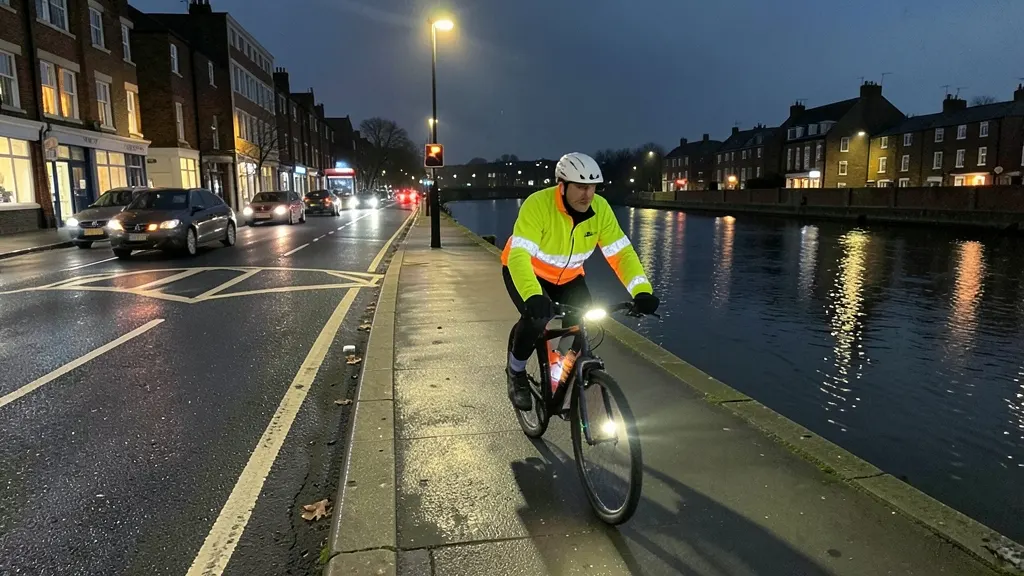
Newcastle upon Tyne is a city of about 300,100 people (2021 census) in North East England. Its economy today rests on science, finance, retail, education, tourism and nightlife, and its past is written in heavy industry. In the 19th century, shipbuilding and heavy engineering were central to the city's prosperity, and that working heritage still shapes the culture of the place.
Why does visibility matter so much here? The answer is the latitude. On the winter solstice in Newcastle upon Tyne, sunrise is at 08:29 and sunset at 15:39, giving 7 hours and 10 minutes of daylight. The clocks go back on 25 October 2026, when sunset in the city is at 16:44. Over a full year there are 126 days when sunset comes before half past five in the evening or sunrise after quarter to eight in the morning, so a normal commute is partly in the dark. If you walk, run, ride or work outdoors here, hi-vis clothing is not a gimmick. It is a practical response to long winter darkness.
What this guide covers
We have built this local guide around three everyday situations.
Dark winter commutes
If you travel to work or study at either end of the day, you will spend a good part of the winter in the dark. Our page on hi-vis for dark winter commutes in Newcastle upon Tyne looks at what to wear on foot, by bike and on public transport, and how the city's short winter days change the maths on visibility.
Running
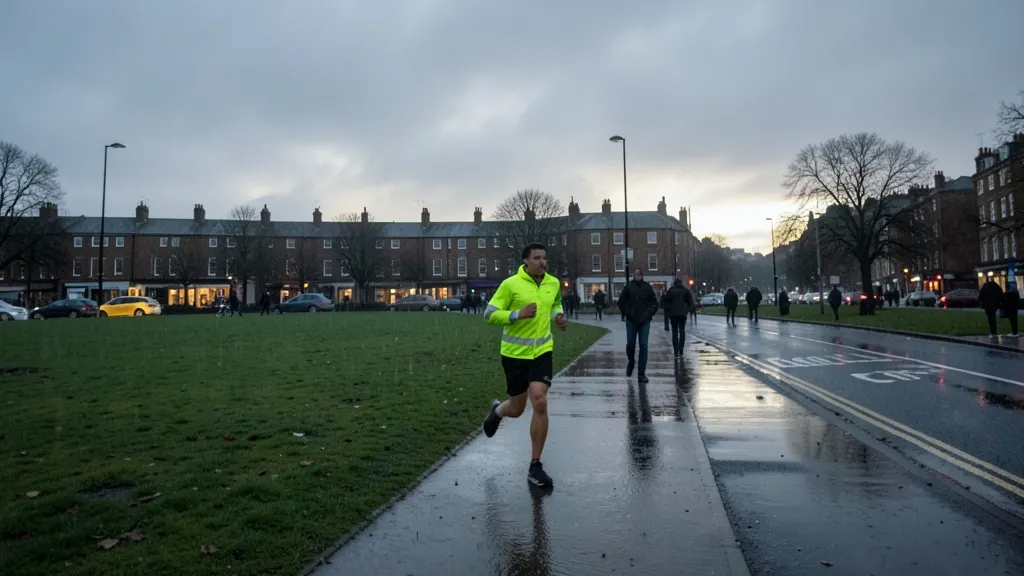
The city gives runners plenty of choice. There is a huge area of open green space in the centre, and a Parkrun (5 km) takes place at 9 am every Saturday on it, while the Great North Run starts on its western edge. In the east of the city there is a wooded gorge linked by two parks to a valley, giving runners traffic-free ground. Our page on hi-vis for running in Newcastle upon Tyne covers jackets, bands and lights for training through winter.
Work and site wear
Shipbuilding and heavy engineering once drove the city's prosperity, and industrial and construction work continues around the Tyne today. If you work on sites, by the river or on the roads, hi-vis is likely to be a requirement rather than a preference. Our general page on high visibility clothing workwear explains how to choose a jacket that meets the right class and survives daily use.
Hi-vis guidance that applies whatever you are doing
A few principles hold for commuters, runners and site workers alike.
Understand the classes. EN ISO 20471 has three classes. The minimum fluorescent background area is 0.14 m2 for class 1, 0.50 m2 for class 2 and 0.80 m2 for class 3. The minimum retroreflective area is 0.10 m2, 0.13 m2 and 0.20 m2 respectively. Class 3 is the highest, so it is the one to look for where traffic is fast or workers are exposed for long periods. If you work in an industry with its own rules, note that rail standard RIS-3279-TOM requires an orange colour and garments that meet at least class 2 of EN ISO 20471, according to SATRA, a UK PPE testing body.
Know what your employer owes you. Under the Personal Protective Equipment at Work Regulations 1992, employers must ensure suitable PPE is provided to workers exposed to a risk to health or safety, unless the risk is adequately controlled by other means. Since 6 April 2022 the PPE duties also cover limb (b) workers, and the employer must provide the PPE free of charge.
Fluorescent by day, reflective by night. Fluorescent material works in daylight and poor light, but it does little in true darkness. Reflective material is what drivers pick out in headlights. Rule 3 of the Highway Code puts it plainly: in the dark, reflective materials such as armbands, sashes, waistcoats, jackets or footwear can be seen by drivers using headlights up to three times as far away as non-reflective materials. Rule 59 makes the same point for cyclists, and Rule 86 and Rule 87 for motorcyclists, who should also make themselves visible from the side as well as the front and rear, for example with fluorescent clothing or strips.
Look after it. HSE guidance says reusable PPE must be cleaned and kept in good condition, and that hi-vis jackets, trousers and coveralls must be cleaned regularly. Grime and wear cut reflective performance. Workers must report any loss, destruction or obvious defect.
Related reading
If you are buying for winter, see winter hi vis jackets: a practical buyer's guide. Rain goes with dark evenings here, so waterproof hi vis jackets: myths and facts is worth a read too. Cyclists will find specific help, including the legal points under Rule 60 on white front and red rear lights and a red rear reflector after dark, in hi-vis jackets for cycling: a buyer's guide. Runners can start with hi-vis jackets for running: how to choose. For a broader view of visibility across the region, our hi-vis jacket North East England local guide covers the wider area.
Newcastle upon Tyne at a glance
- Nation: England
- Region: North East England
- Population: 300100
| Measure | Time |
|---|---|
| Sunrise on the winter solstice | 08:29 |
| Sunset on the winter solstice | 15:39 |
| Daylight on the winter solstice | 7h 10m |
| Sunset when the clocks go back (2026-10-25) | 16:44 |
| Days a year with a dark commute | 126 |
Frequently asked questions
How dark are winter commutes in Newcastle upon Tyne?
There are 126 days a year in the city when sunset comes before half past five in the evening or sunrise after quarter to eight in the morning. On the winter solstice, sunrise is at 08:29 and sunset at 15:39. That means many people travel to and from work or study in low light or darkness.
What class of hi-vis jacket do I need for work?
EN ISO 20471 has three classes. Class 2 has at least 0.50 m2 of fluorescent background material and 0.13 m2 of retroreflective material, while class 3 has at least 0.80 m2 and 0.20 m2. Class 3 is the highest class and suits the riskiest settings. If you work on the railway, rail standard RIS-3279-TOM requires an orange colour and at least class 2 of EN ISO 20471, according to SATRA, a UK PPE testing body.
Does my employer have to provide my hi-vis jacket?
Under the Personal Protective Equipment at Work Regulations 1992, employers must ensure suitable PPE is provided to workers exposed to a risk to health or safety, unless the risk is adequately controlled by other means. Since 6 April 2022 these duties also cover limb (b) workers, and the employer must provide the PPE free of charge.
Is reflective material really better than bright colours at night?
Yes. Rule 3 of the Highway Code notes that in the dark, reflective materials such as armbands, sashes, waistcoats, jackets or footwear can be seen by drivers using headlights up to three times as far away as non-reflective materials. Fluorescent colour helps in daylight and poor light, but reflective detail is what counts in true darkness.