Hi-vis clothing in Durham
Last updated
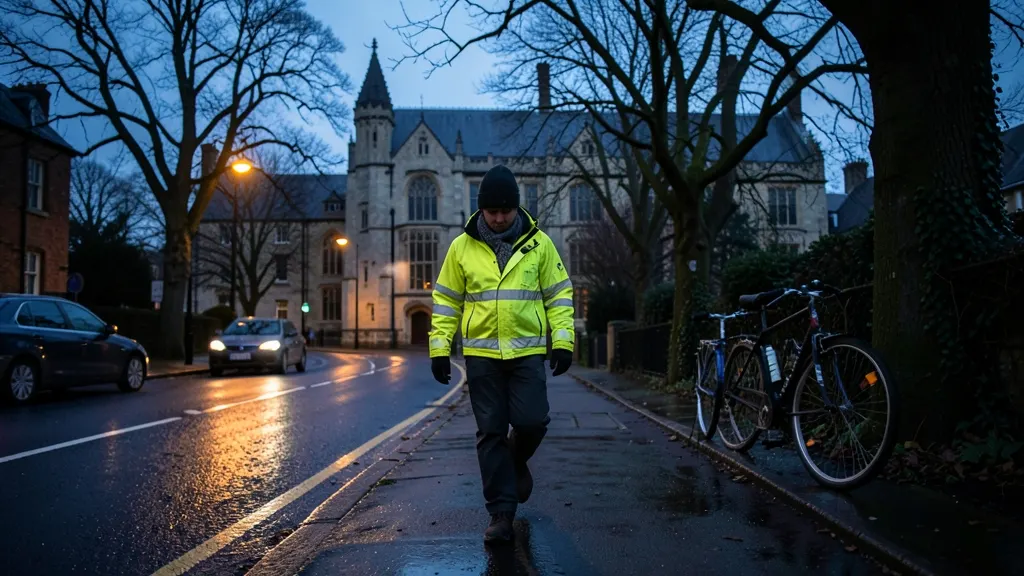
Durham is a small, steep city of around 50,510 people in the North East of England. The River Wear loops around the centre on three sides, and the riverbanks are densely wooded, so much of the city sits in a valley with winding roads climbing in and out of it. The city claims to be built upon seven hills, which in practice means plenty of narrow, twisting streets and junctions where drivers are watching the road rather than the pavement.
The big employer here is Durham University, founded in 1832, alongside the local council and national government offices. Tourism and hospitality are also significant. That mix matters for visibility. During term time, the streets carry students walking to lectures at all hours, hospitality staff heading home late, and commuters going to and from work.
The winter light is the real issue. On the winter solstice in Durham, the sun rises at 08:27 and sets at 15:40, giving just 7 hours and 13 minutes of daylight. When the clocks go back on 25 October 2026, sunset that day is at 16:44, and the afternoons only get shorter from there. In total, Durham sees 126 days a year when sunset comes before half past five in the evening or sunrise after quarter to eight in the morning. Anyone with a normal commute spends part of it in the dark.
There is one small compensation. Durham has an average of 124.14 rainy days a year with more than 1 mm of rain, compared with a national average of 159.08 days (Met Office 1991 to 2020), so it is drier than much of the country. Dry evenings are still dark evenings, though, and the city's hilly streets and wooded riverbanks make contrast poor in low light. A hi-vis jacket in Durham is a sensible piece of everyday kit, not just something for roadworkers.
What this guide covers
We have split our Durham advice into the activities where visibility matters most:
- Dark winter commutes. With sunset well before the end of the working day for a third of the year, students, walkers and cyclists need gear that shows up in headlights. Our winter hi vis jackets: a practical buyer's guide explains what to look for, and we cover the wider region in Hi-vis jacket North East England: local guide.
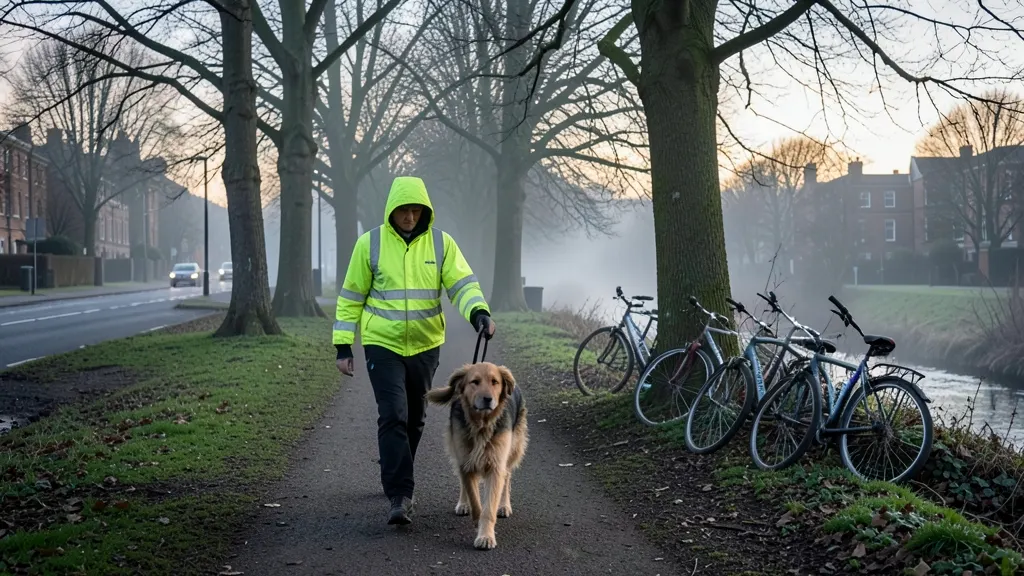
- Dog walking. The wooded riverbanks around the centre are popular walking routes, and woodland shade makes both dogs and owners hard to see. Our page on Hi-vis for dog walking in Durham goes into local detail, and Hi-vis jackets for dog walking: how to choose covers the general principles.
- Horse riding. Durham is completely surrounded by green belt, so riders have rural lanes close to the city. See Hi-vis for horse riding in Durham for local advice, and Hi-vis jackets for horse riding: a buyer's guide for what to buy.
General hi-vis guidance for Durham
A few principles hold true whatever you are doing in the city.
Fluorescent for daylight, reflective for the dark. The Highway Code (Rule 59) puts it plainly: light-coloured or fluorescent clothing helps other road users see a cyclist in daylight and poor light, while reflective clothing or accessories such as belts, arm and ankle bands increase visibility after dark. Rule 3 adds that reflective materials can be seen by drivers using headlights up to three times as far away as non-reflective materials. On a December afternoon, that extra distance is what gives a driver time to slow down on a wet hill.
Match the jacket to the journey. If you cycle, Rule 60 requires a white front light, a red rear light and a red rear reflector at night; clothing is the second line of defence, not the first. If you walk the dog in the woods, a yellow or orange jacket with reflective panels on the sleeves works well because the reflective strips move with your arms. Riders should follow Rule 86 and make themselves visible from the side as well as from the front and rear, for example with fluorescent clothing or strips.
Check the class if you need certified gear. EN ISO 20471 has three classes, based on the area of fluorescent and retroreflective material. Class 2, with at least 0.50 m2 of fluorescent background material and 0.13 m2 of retroreflective material, is the common choice for work near traffic. Class 3, the highest, requires at least 0.80 m2 of fluorescent material and 0.20 m2 of retroreflective material. If you work in the city, note that under the Personal Protective Equipment at Work Regulations 1992 your employer must provide suitable PPE where there is a risk to health or safety, and since 6 April 2022 those duties also cover limb (b) workers, with the kit provided free of charge.
Look after what you buy. HSE guidance says reusable PPE must be cleaned and kept in good condition, and hi-vis jackets, trousers and coveralls must be cleaned regularly. A jacket that is grey with road grime or has a broken zip is not doing its job. Wash reflective gear according to the label, keep it out of direct sunlight when stored, and replace it when the retroreflective strips stop catching headlights.
Where to read next
For the city's three main visibility challenges, start with the local pages: Hi-vis for dog walking in Durham and Hi-vis for horse riding in Durham. Cyclists and commuters will find the buying advice in Hi-vis jackets for cycling: a buyer's guide useful, and if wet weather is your main worry, read Waterproof hi vis jackets: myths and facts before you spend any money.
Durham at a glance
- Nation: England
- Region: North East England
- Population: 50510
| Measure | Time |
|---|---|
| Sunrise on the winter solstice | 08:27 |
| Sunset on the winter solstice | 15:40 |
| Daylight on the winter solstice | 7h 13m |
| Sunset when the clocks go back (2026-10-25) | 16:44 |
| Days a year with a dark commute | 126 |
Frequently asked questions
Why does hi-vis matter so much in Durham in winter?
Durham sees 126 days a year when sunset comes before half past five in the evening or sunrise after quarter to eight in the morning, so a normal commute is partly in the dark. On the winter solstice the city gets only 7 hours and 13 minutes of daylight. The wooded riverbanks and hilly streets also reduce contrast, making pedestrians and cyclists harder for drivers to spot.
What kind of hi-vis jacket is best for dark commutes?
Choose a jacket with both fluorescent background material and retroreflective strips. The Highway Code notes that reflective materials can be seen by drivers using headlights up to three times as far away as non-reflective ones. If you cycle, remember that a white front light, red rear light and red rear reflector are required at night, with clothing adding extra visibility.
Do I need hi-vis when walking my dog in Durham?
The densely wooded riverbanks around the city centre are popular walking routes, and shade makes you and your dog less visible in low light. A hi-vis jacket with reflective panels, plus a reflective lead or collar for the dog, helps drivers and cyclists see you both. Our Durham dog walking page has more detailed advice.
Do employers in Durham have to provide hi-vis clothing?
Under the Personal Protective Equipment at Work Regulations 1992, employers must provide suitable PPE to workers exposed to a risk to health or safety, unless the risk is controlled by other means. Since 6 April 2022 these duties also cover limb (b) workers, and the PPE must be provided free of charge.
How should I care for a hi-vis jacket?
HSE guidance says reusable PPE must be cleaned and kept in good condition, and hi-vis jackets must be cleaned regularly. Follow the washing label, avoid harsh detergents that can dull reflective strips, and report any loss or obvious defect. Replace the garment when the reflective material no longer shines clearly in headlights.