Hi-vis clothing in Carlisle: a local guide
Last updated
Carlisle sits close to the Anglo-Scottish border, and its nickname, the Great Border City, hints at a place shaped by routes rather than scenery alone. The M6 links it to the south and the A74(M)/M74 runs north into Scotland, while the A6, A595, A69 and A7 all begin or end here. That concentration of roads matters when you are deciding what to wear on the school run, the ride out, the walk with the dog or the trip home from work.
The city's history explains some of the traffic. Carlisle grew around textile mills, engineering works and food manufacturers, and several road haulage firms have been headquartered here. Haulage means lorries, often early in the morning and late at night, sharing roads with everyone else. The city was also a major railway centre on the West Coast Main Line, with seven companies once using the Citadel station, so shift work has long been part of local life.
Then there is the weather. Carlisle records 152.6 days a year with 1.0 mm or more of rain at the station, using the 1991 to 2020 averages. Damp air, grey skies and low winter light all reduce how far drivers can see you. On the winter solstice, sunrise is at 08:34 and sunset at 15:45, giving just 7 hours 11 minutes of daylight. The clocks go back on 25 October 2026, and sunset in Carlisle that day is at 16:49. In total, there are 126 days a year when sunset comes before half past five or sunrise comes after quarter to eight, which means a normal commute is partly in the dark.
What this guide covers
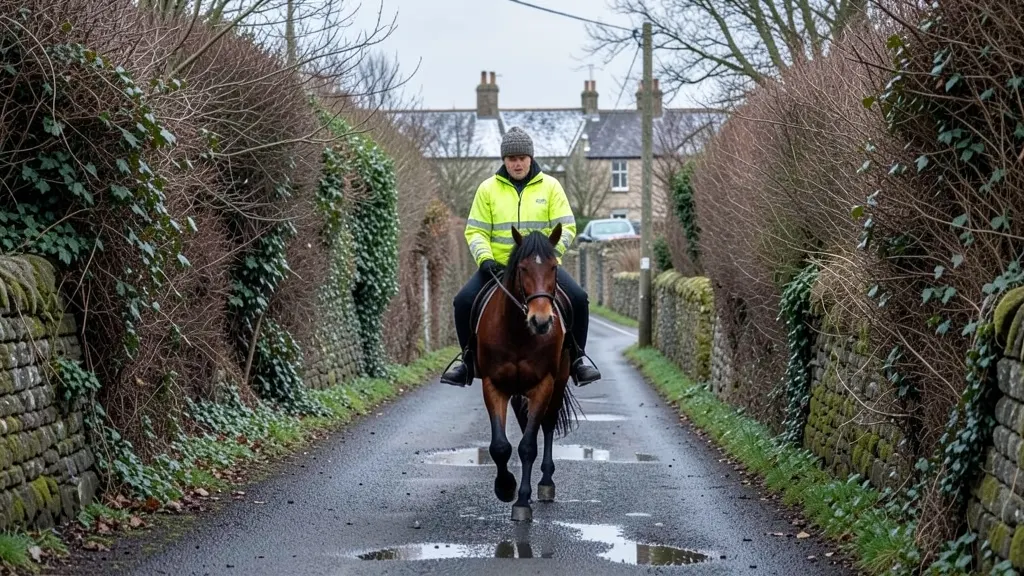
With a built-up area population of 77,730 at the 2021 census, Carlisle is a market town in all but size, surrounded by working farmland and quiet rural lanes. Riders use those lanes regularly, and a horse and rider in poor light are easy to miss. Our page on hi-vis jackets for horse riding in Carlisle looks at what to wear on horseback here, and it draws on the wider advice in hi-vis jackets for horse riding: a buyer's guide.
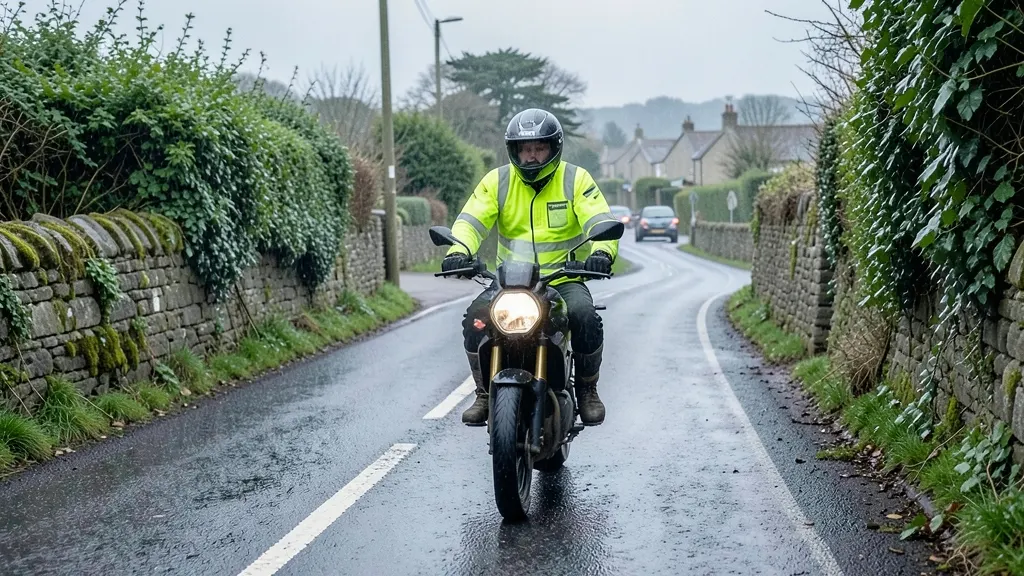
Motorcyclists are drawn to the roads that fan out from the city, and the A7 and A69 in particular carry fast traffic in changeable weather. Rule 86 of the Highway Code says riders should make themselves as visible as possible from the side as well as the front and rear, for example with fluorescent clothing or strips. Rule 87 adds that in the dark, riders should wear reflective clothing or strips. See hi-vis for motorcyclists in Carlisle and, for the general picture, motorcycle hi vis jackets: myths and facts.
The third theme is the dark commute. With sunrise at 08:34 at midwinter, many people set off for work before the sky is properly light, and with sunset at 15:45 the journey home happens after dark. Cyclists are a big part of this picture, since National Cycle Route 72, Hadrian's Cycleway, passes through the city. Rule 59 says light-coloured or fluorescent clothing can help other road users see a cyclist in daylight and poor light, while reflective clothing or accessories such as belts, arm bands or ankle bands increase visibility in the dark. Rule 60 requires a white front light and a red rear light, lit at night, plus a red rear reflector.
General hi-vis guidance for Carlisle
A few principles apply whatever you are doing.
Choose the right class for the job. EN ISO 20471 has three classes. Class 1 requires a minimum of 0.14 m2 of fluorescent background material and 0.10 m2 of retroreflective material. Class 2 needs at least 0.50 m2 fluorescent and 0.13 m2 reflective. Class 3, the highest, needs 0.80 m2 fluorescent and 0.20 m2 reflective. For road-side work or riding on fast rural roads, class 2 is generally the sensible minimum, and class 3 gives the most coverage.
Understand the difference between fluorescent and reflective. Fluorescent material helps in daylight and poor light, such as an overcast, drizzly afternoon. Retroreflective material only shows up when light hits it, which makes it essential after dark. Rule 3 of the Highway Code notes that reflective materials such as armbands, sashes, waistcoats, jackets or footwear can be seen by drivers using headlights up to three times as far away as non-reflective materials. Rule 17 puts it simply: at night, wear something reflective.
Look after what you own. HSE guidance says reusable PPE must be cleaned and kept in good condition, and hi-vis jackets, trousers and coveralls must be cleaned regularly, with workers reporting any loss or obvious defect. Mud from farm lanes and rain on the A69 both dull a garment's performance, so wash hi-vis according to the label and replace anything faded or cracked.
Know the rules if you employ people. Under the Personal Protective Equipment at Work Regulations 1992, employers must provide suitable PPE to workers exposed to a health or safety risk unless that risk is controlled by other means. Since 6 April 2022 those duties also cover limb (b) workers, and the PPE must be provided free of charge. If you work on the railways, note that the standard RIS-3279-TOM requires an orange colour and garments meeting at least class 2 of EN ISO 20471, according to the UK testing body SATRA.
Where to go next
Start with the Carlisle pages for your own activity: hi-vis jackets for horse riding in Carlisle and hi-vis for motorcyclists in Carlisle. For the broader region, see hi-vis clothing in North West England. If rain is your main worry, as it often is here, waterproof hi vis jackets: myths and facts is worth a read, and winter hi vis jackets: a practical buyer's guide covers the colder, darker months. Cyclists can find specific advice in hi-vis jackets for cycling: a buyer's guide.
Carlisle at a glance
- Nation: England
- Region: North West England
- Population: 77730
| Measure | Time |
|---|---|
| Sunrise on the winter solstice | 08:34 |
| Sunset on the winter solstice | 15:45 |
| Daylight on the winter solstice | 7h 11m |
| Sunset when the clocks go back (2026-10-25) | 16:49 |
| Days a year with a dark commute | 126 |
Frequently asked questions
Is a hi-vis jacket enough on its own for dark winter commutes in Carlisle?
A jacket is a good start but not the whole answer. Fluorescent material works best in daylight and poor light, while retroreflective material is what shows up under headlights after dark, and both matter given Carlisle's short winter days. Rule 3 of the Highway Code notes that reflective materials can be seen by drivers using headlights up to three times as far away as non-reflective materials, so add reflective bands or accessories for extra coverage.
What class of hi-vis should I look for?
EN ISO 20471 has three classes. Class 1 needs at least 0.14 m2 of fluorescent material and 0.10 m2 of retroreflective material, class 2 needs 0.50 m2 and 0.13 m2, and class 3 needs 0.80 m2 and 0.20 m2. For road use around Carlisle, class 2 is generally the sensible minimum, and class 3 offers the highest level of visibility.
Do motorcyclists have to wear hi-vis?
There is no legal requirement, but the Highway Code does set an expectation. Rule 86 says riders should make themselves as visible as possible from the side as well as the front and rear, for example with fluorescent clothing or strips, and Rule 87 says that in the dark riders should wear reflective clothing or strips.
Does my employer have to provide hi-vis clothing?
Under the Personal Protective Equipment at Work Regulations 1992, employers must provide suitable PPE to workers exposed to a health or safety risk unless that risk is controlled by other means. Since 6 April 2022 these duties also cover limb (b) workers, and the employer must provide the PPE free of charge. HSE guidance also requires hi-vis garments to be cleaned regularly and kept in good condition.
How bad are winter mornings in Carlisle for visibility?
On the winter solstice, sunrise in Carlisle is at 08:34 and sunset is at 15:45, giving 7 hours 11 minutes of daylight. There are 126 days a year when sunset comes before half past five or sunrise after quarter to eight, so a normal commute is partly in the dark.