Hi-vis clothing in Kingston upon Hull
Last updated

Kingston upon Hull, known to most people simply as Hull, is a Yorkshire port city with an estimated population of 273,257 in 2025. Its working life has always been tied to the water, from whaling and sea fishing in earlier centuries to the heavy industry that followed, and it remains a busy port today, handling 13 million tonnes of cargo a year. Port operations run by Associated British Ports and other companies employ 5,000 people, with a further 18,000 jobs resulting directly from that port activity. In 2011, Siemens Wind Power and Associated British Ports agreed a wind turbine blade manufacturing plant at Alexander Dock, adding offshore wind work to the mix.
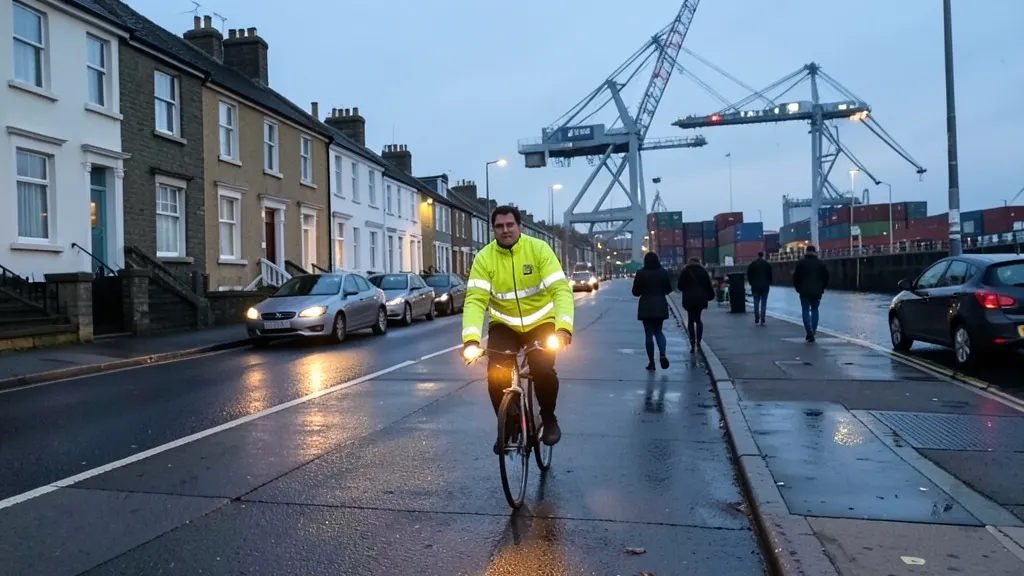
What does all this mean for visibility? A great deal. A city with thousands of people working outdoors around docks, cargo, construction and logistics needs clothing that keeps them seen. Beyond the industrial side, Hull is a genuinely flat city, and the land within it is generally very flat, which helps explain why cycling here is well above the national average. A 2001 census recorded a 12% share of travel to work by bike, and a 2011 report ranked Hull the fourth-best cycling city in the UK. And then there is the winter. On the winter solstice in Kingston upon Hull, sunrise is at 08:16 and sunset at 15:41, giving just 7 hours and 25 minutes of daylight. There are 123 days a year when sunset comes before half past five in the evening or sunrise after quarter to eight in the morning, so a normal commute is partly in the dark.
We have put together a set of pages for Hull covering the three situations where visibility matters most to local people.
What we cover for Hull
If you work outdoors or around the port and logistics sites, start with our guide to Hi-vis for work and site wear in Kingston upon Hull. It looks at what the jobs around the docks and the wind industry demand from a hi vis jacket and matching trousers, and how the rules on employer-provided PPE apply.
If you ride to work, see Hi-vis for cycling and commuting in Kingston upon Hull. Flat ground makes cycling an easy choice here, and that page covers jackets, accessories and lighting in plain terms.
If you leave for work or head home in the dark, read Hi-vis for dark winter commutes in Kingston upon Hull. With more than a third of the year involving commutes in poor light or darkness, it covers layering hi-vis over winter clothing and what to check when the clocks go back, which falls on 25 October 2026, when sunset in Hull is at 16:42.
Hi-vis guidance that applies across the board
A few principles hold true whatever you are doing and whichever garment you buy.
Understand the classes. EN ISO 20471 has three classes, based on how much fluorescent background material and retroreflective material a garment carries. The minimum fluorescent background area is 0.14 m2 for class 1, 0.50 m2 for class 2 and 0.80 m2 for class 3, with minimum retroreflective areas of 0.10, 0.13 and 0.20 m2 respectively. Class 3 is the highest. For most workwear around vehicles and machinery, class 2 is the common baseline, and for anyone working in higher-risk settings, class 3 gives the greatest visibility. SATRA, a UK PPE testing body, notes that rail standard RIS-3279-TOM requires an orange colour and garments meeting at least class 2 of EN ISO 20471.
Know what your employer must provide. Under the Personal Protective Equipment at Work Regulations 1992, employers must ensure suitable PPE is provided to workers exposed to a risk to health or safety, unless the risk is adequately controlled by other means. Since 6 April 2022, these duties also cover limb (b) workers, and the employer must provide the PPE free of charge. If you work at the port or on a site, ask before buying your own.
Look after what you own. HSE guidance says reusable PPE must be cleaned and kept in good condition, and that hi-vis jackets, trousers and coveralls must be cleaned regularly. Workers must report any loss, destruction or obvious defect. A grubby jacket loses much of its fluorescent punch, so washing matters as much as buying well.
Match the light to the garment. The Highway Code is clear on this. Rule 3 advises helping other road users to see you, and notes that reflective materials such as armbands, sashes, waistcoats, jackets or footwear can be seen by drivers using headlights up to three times as far away as non-reflective materials. Rule 59 makes the distinction for cyclists: light-coloured or fluorescent clothing helps in daylight and poor light, while reflective clothing or accessories such as belts, arm or ankle bands increase visibility in the dark. Fluorescent colours need some light to work, so on a December evening in Hull, reflective strips do the real work. Rule 60 also requires a cycle to have white front and red rear lights lit at night, plus a red rear reflector, so clothing is a supplement to lighting rather than a substitute.
Related pages worth reading
For broader background, our Hi-vis clothing in Yorkshire: a regional guide covers the county as a whole. If you are shopping for a work jacket, see High visibility clothing workwear: choosing a hi vis jacket. Cyclists should also read Hi-vis jackets for cycling: a buyer's guide. For the colder months, Winter hi vis jackets: a practical buyer's guide and Waterproof hi vis jackets: myths and facts will help you choose something that copes with Yorkshire weather as well as the dark.
Whatever your reason for being out on Hull's flat streets or around its working docks, the same rule applies: be seen, and make it easy for others to see you.
Kingston upon Hull at a glance
- Nation: England
- Region: Yorkshire
- Population: 273257
| Measure | Time |
|---|---|
| Sunrise on the winter solstice | 08:16 |
| Sunset on the winter solstice | 15:41 |
| Daylight on the winter solstice | 7h 25m |
| Sunset when the clocks go back (2026-10-25) | 16:42 |
| Days a year with a dark commute | 123 |
Frequently asked questions
What class of hi-vis do I need for port or construction work in Hull?
For most work around vehicles, plant and machinery, class 2 of EN ISO 20471 is the common minimum, with at least 0.50 m2 of fluorescent background material and 0.13 m2 of retroreflective material. Higher-risk settings call for class 3, which requires at least 0.80 m2 of fluorescent material and 0.20 m2 of retroreflective material. Your employer's risk assessment should set the requirement, and under the Personal Protective Equipment at Work Regulations 1992 the employer must provide suitable PPE free of charge.
Is cycling in Hull common, and do I need hi-vis?
Yes, cycling is well above the national average here, with a 12% share of travel to work recorded in the 2001 census, and a 2011 report ranked Hull the fourth-best cycling city in the UK. The Highway Code's Rule 59 advises light-coloured or fluorescent clothing in daylight and poor light, and reflective clothing or accessories in the dark. At night you must also have white front and red rear lights lit and a red rear reflector on the bike.
How dark are winter commutes in Hull?
On the winter solstice, sunrise in Kingston upon Hull is at 08:16 and sunset at 15:41, giving 7 hours and 25 minutes of daylight. There are 123 days a year when sunset comes before half past five in the evening or sunrise after quarter to eight in the morning. That means many commutes are partly in the dark, so reflective material matters as much as fluorescent.
How often should I wash my hi-vis jacket?
HSE guidance says reusable PPE must be cleaned and kept in good condition, and that hi-vis jackets, trousers and coveralls must be cleaned regularly. Dirt and grime reduce both the fluorescent colour and the reflective performance. Workers must report any loss, destruction or obvious defect to their employer.
Do reflective materials really make a difference at night?
Yes. The Highway Code, Rule 3, notes that reflective materials such as armbands, sashes, waistcoats, jackets or footwear can be seen by drivers using headlights up to three times as far away as non-reflective materials. That extra distance gives a driver more time to react, which is the whole point of wearing it.