Hi-vis clothing in Edinburgh
Last updated
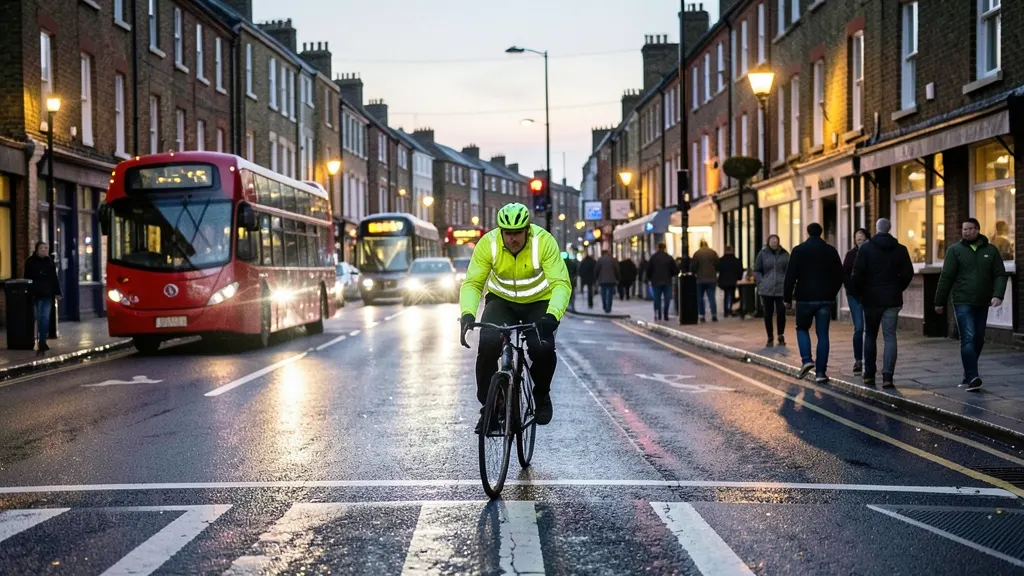
Edinburgh is a compact, busy city with a population of 531,370 in the council area (2025 estimate). Financial services now take up a third of all commercial office space, so a large share of the working population travels into and around the centre each day. The city also has four universities, including the University of Edinburgh, founded in 1582, which adds tens of thousands of students walking, cycling and running through the same streets.
Visibility matters here for a simple reason: the light is often poor. On the winter solstice in Edinburgh the sun rises at 08:42 and sets at 15:39, giving just 6h 58m of daylight. Across a full year there are 128 days when sunset comes before half past five in the evening or sunrise after quarter to eight in the morning. For many people, that means at least one leg of the daily commute happens in the dark.
There is also the traffic mix. Edinburgh Trams became operational on 31 May 2014, and trams share street space with buses, cars, cyclists and pedestrians. Meanwhile the city offers plenty of green space for exercise: Holyrood Park covers 650 acres (260 ha), with Arthur's Seat, an extinct volcano and the highest point in Edinburgh, at its centre. Princes Street Gardens and Corstorphine Hill are among the other green spaces. The Water of Leith Walkway, a mixed-use trail that follows the river for 19.6 km, is popular with walkers, runners and commuters alike.
What this guide covers
We have split our Edinburgh advice into three themed pages so you can go straight to what matters to you.
If you ride a bike in the city, start with Hi-vis for cycling and commuting in Edinburgh. It covers what to wear on busy streets, how hi-vis interacts with your legal lighting duties, and what to look for in a hi vis jacket edinburgh style garment.
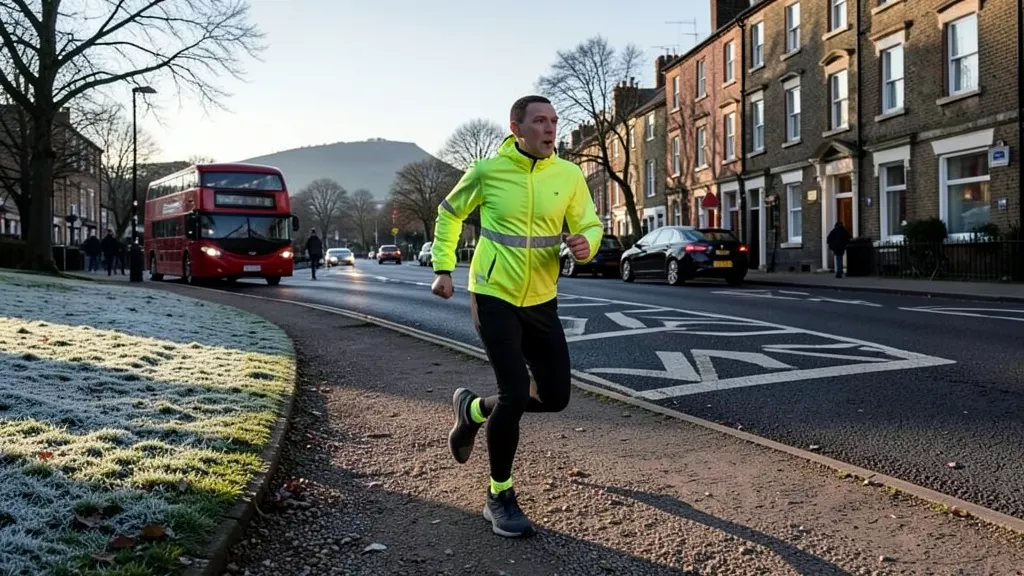
If you run, see Hi-vis for running in Edinburgh. Runners heading out early or late need a different kind of garment to commuters: lighter, breathable and with reflectives placed where moving limbs catch headlights. Our general page on hi-vis jackets for running explains the choices.
If you walk, wait for a bus, drive or ride to work in the darker months, read Hi-vis for dark winter commutes in Edinburgh. With the clocks going back on 25 October 2026, when sunset that day is at 16:48, the dark commuting season starts early and lasts months.
Hi-vis guidance that applies across themes
Fluorescent for day, reflective for dark
Fluorescent material works in daylight and poor light by converting ultraviolet into extra visible brightness. It does nothing useful in full darkness. Retroreflective material, the silver bands and panels on a hi-vis jacket, bounces headlight beams straight back at drivers. The Highway Code makes this split explicit. Rule 59 says light-coloured or fluorescent clothing helps other road users see a cyclist in daylight and poor light, while reflective clothing or accessories such as belts, arm bands or ankle bands increase visibility in the dark.
Rule 3 adds a useful number: in the dark, reflective materials such as armbands, sashes, waistcoats, jackets or footwear can be seen by drivers using headlights up to three times as far away as non-reflective materials. That gap matters most where drivers have little time to react, which in a busy city is most journeys.
What the classes mean
If you see an EN ISO 20471 label, the number tells you how much fluorescent and retroreflective material the garment contains. Class 1 is the minimum, with at least 0.14 m2 of fluorescent background material and 0.10 m2 of retroreflective material. Class 2 requires 0.50 m2 fluorescent and 0.13 m2 retroreflective. Class 3 is the highest class, with at least 0.80 m2 of fluorescent background material and 0.20 m2 of retroreflective material.
For commuting, running and cycling, most people find class 2 clothing gives a good balance of visibility, comfort and price. Class 3 suits the darkest or fastest-risk situations, and higher classes can be achieved by combining garments, such as a jacket plus trousers.
Legal points worth knowing
Rule 60 of the Highway Code requires a cycle used at night to have white front and red rear lights lit, plus a red rear reflector. Hi-vis clothing is a supplement to this, never a replacement. Rule 17 tells pedestrians that at night they should wear something reflective. Motorcyclists are covered too: Rule 86 says they should make themselves as visible as possible from the side as well as the front and rear, for example with fluorescent strips, and Rule 87 says that when riding in the dark they should wear reflective clothing or strips.
If your hi-vis is provided by an employer, the Personal Protective Equipment at Work Regulations 1992 apply. Employers must provide suitable PPE free of charge to workers exposed to a health or safety risk. Since 6 April 2022 those duties also cover limb (b) workers. HSE guidance adds that reusable PPE, including hi-vis jackets, must be cleaned regularly and kept in good condition, and workers must report any loss or obvious defect.
Looking after hi-vis in a wet city
Dirty reflectives stop reflecting. Wash hi-vis garments regularly, follow the label, and avoid tumble drying or scrubbing the reflective panels, both of which dull them. Check reflective strips under a torch every so often. If they no longer shine clearly, the garment is failing its one job. Reflective material that has lost its shine is a good reason to replace a jacket, even if the fabric is still sound.
For wet weather, our page on waterproof hi vis jackets looks at what the claims mean and what to expect. For cold months, winter hi vis jackets covers insulation, layering and keeping reflectives effective.
Where to go next
Choose the page that matches how you move around Edinburgh:
- Cyclists and bike commuters: Hi-vis for cycling and commuting in Edinburgh
- Runners: Hi-vis for running in Edinburgh
- Walkers, drivers and riders in the dark months: Hi-vis for dark winter commutes in Edinburgh
If you travel beyond the city, our broader page on Hi-vis clothing in Scotland: where you need it covers requirements and conditions across the country.
Edinburgh at a glance
- Nation: Scotland
- Region: Scotland
- Population: 531370
| Measure | Time |
|---|---|
| Sunrise on the winter solstice | 08:42 |
| Sunset on the winter solstice | 15:39 |
| Daylight on the winter solstice | 6h 58m |
| Sunset when the clocks go back (2026-10-25) | 16:48 |
| Days a year with a dark commute | 128 |
Frequently asked questions
What class of hi-vis should I wear for commuting in Edinburgh?
Class 2 under EN ISO 20471 is a sensible choice for most commuters, with at least 0.50 m2 of fluorescent background material and 0.13 m2 of retroreflective material. It offers strong visibility without being bulky or hot. Class 3, with at least 0.80 m2 of fluorescent and 0.20 m2 of retroreflective material, suits the darkest routes or faster traffic.
Is hi-vis clothing legally required for cyclists in Edinburgh?
Hi-vis clothing is not legally required. Rule 60 of the Highway Code requires a cycle used at night to have white front and red rear lights lit and a red rear reflector, and those are the legal items. Rule 59 advises that light-coloured or fluorescent clothing helps other road users see a cyclist in daylight and poor light, and reflective clothing or accessories increase visibility in the dark.
Why does hi-vis matter so much in an Edinburgh winter?
On the winter solstice in Edinburgh the sun rises at 08:42 and sets at 15:39, giving only 6h 58m of daylight. There are 128 days a year when sunset comes before half past five or sunrise after quarter to eight, so a normal commute is partly in the dark for a large part of the year.
How far away can drivers see reflective clothing?
Rule 3 of the Highway Code states that in the dark, reflective materials such as armbands, sashes, waistcoats, jackets or footwear can be seen by drivers using headlights up to three times as far away as non-reflective materials. This is why reflective panels matter more than fluorescent colour after dark.
How often should I wash a hi-vis jacket?
HSE guidance says hi-vis jackets, trousers and coveralls must be cleaned regularly and kept in good condition, and workers must report any loss, destruction or obvious defect. For everyday use, wash following the label whenever the garment is visibly dirty, because dirt and grime stop reflective strips working properly.